
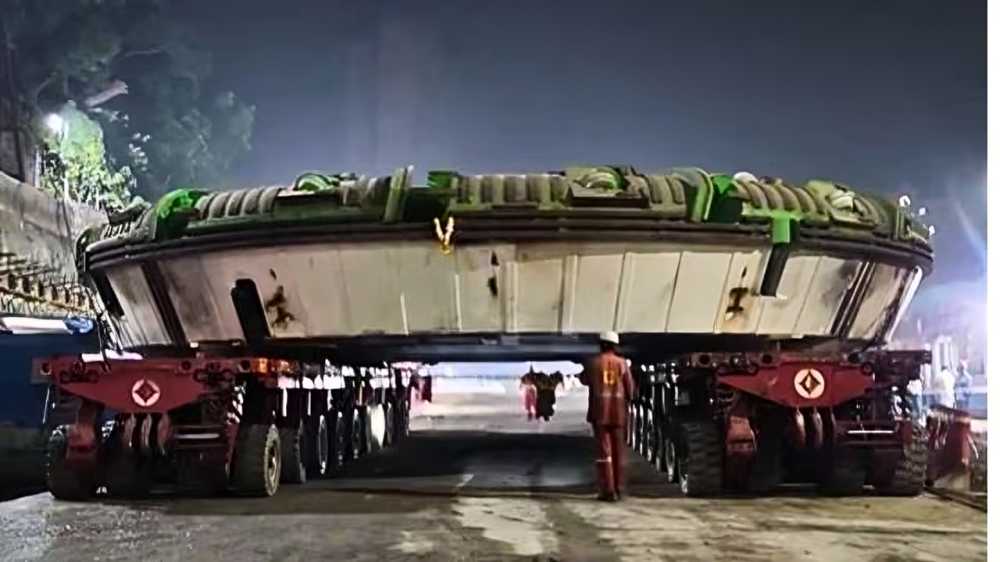
December 1, 2025: In a major boost to Mumbai’s most ambitious underground mobility initiative, the Mumbai Metropolitan Region Development Authority (MMRDA) has successfully lowered India’s largest tunnel boring machine (TBM) for the Thane–Borivali twin tunnel project. The machine, a 13.34-metre single shield TBM—the biggest ever used in the country—was lowered into the Thane launch shaft on Saturday by MEIL Group, the contractor executing the tunnelling work. This marks a critical step toward constructing what will become India’s longest and widest urban road tunnel.
The project features two parallel three-lane tunnels stretching 11.8 km beneath the Sanjay Gandhi National Park, linking Ghodbunder Road with the Western Express Highway. Once operational, it is expected to reduce the current 60- to 90-minute commute to approximately 15 minutes. Excavation for the launch shaft began in October 2024 and has now reached its final stages, with tunnelling slated to begin between February and March next year.
Officials have described the twin tunnels as one of the most technically demanding undertakings in the region due to the fragile ecology of the national park, the strict requirement for minimal surface disturbance, and the need for continuous monitoring of geological behaviour. To address these challenges, MMRDA is deploying advanced Single Shield TBMs capable of navigating variable rock conditions and high overburden. Two machines, ‘Nayak’ and ‘Arjuna’, sourced from Herrenknecht’s Chennai facility, will spearhead the excavation.
Key work fronts are progressing steadily. The Thane casting yard is already supplying precast segments, while preparations continue at the Borivali yard. Land acquisition is nearly finished on the Thane side, and rehabilitation of project-affected residents in Borivali has accelerated after earlier delays. The Thane launch shaft, among the deepest in an urban setting, has been excavated with strict vibration-control measures, while the Borivali shaft will reach full depth next year.
The tunnels will include three lanes each, along with an emergency lane, cross-passages at 300-metre intervals and safety features such as firefighting lines, smoke detection, CCTV systems and dedicated ventilation. Environmental safeguards remain central, with real-time monitoring and groundwater regulation in place. “The design and implementation have been planned to ensure zero encroachment and minimal impact on the forest cover,” an official said.
With tunnelling soon to begin from both ends, officials called the TBM lowering a critical milestone. “This is a major milestone that signals Mumbai’s readiness to take up challenging underground mobility projects,” an MMRDA official said. Once completed, the Thane–Borivali twin tunnel is expected to ease congestion across northern Mumbai and transform east–west connectivity for lakhs of daily commuters.
Source: The Indian Express