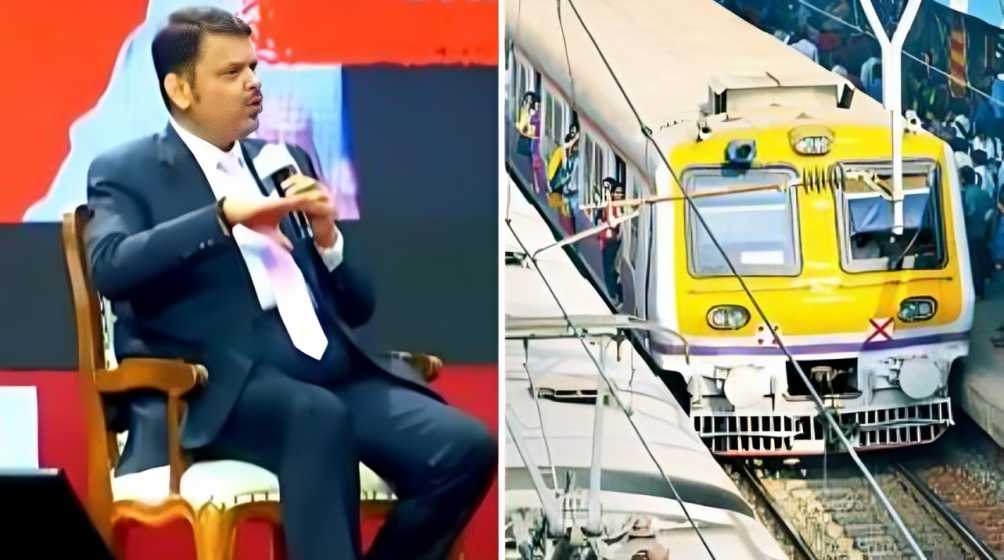

November 24, 2025: Maharashtra Chief Minister Devendra Fadnavis on Monday, November 24, announced plans to transform Mumbai’s local trains to metro-like infrastructure, complete with air-conditioned coaches and automated doors, while keeping second-class fares unchanged. Speaking at the IIMUN Youth Connect session on “Involvement of Youth in Governance,” he said, “We are transforming Mumbai local train completely, like a metro, fully air-conditioned, and its doors are going to be closed, but we will not increase the fare of the second class by a single rupee.”
Highlighting the severe congestion in suburban trains, CM Fadnavis noted that Mumbai’s railway system carries around 90 lakh passengers daily, making it the city’s lifeline. “Our suburban railway, which is Mumbai’s lifeline, which transports about 90 lakh people, but even today, people hang around in the suburban railway and only the real Mumbaikar can travel,” he said. The AC coaches and automated doors are part of a broader effort to modernize the network and enhance the commuter experience during peak hours.
Addressing traffic woes in the city, Fadnavis said, “Traffic congestion is a big problem of Mumbai. To get relief from this problem, the government is constructing various roads and subways, along with a metro network.” He also highlighted the creation of underground corridors, or “Paatal Lok,” aimed at permanently easing congestion, stating, “Once these ‘Paatal Lok’ are created, Mumbaikars will be permanently free from traffic congestion.”
On public transport integration, CM Fadnavis promised that within the next four years, Mumbai will have 100% metro connectivity, enabling seamless travel across the city. He lauded the Mumbai One App as a one-stop solution for planning journeys, buying tickets for local trains, buses, metro, and other platforms.
He also highlighted Mumbai’s first Ro-Ro water transport service from Gateway of India to Alibaug and said the Navi Mumbai International Airport will be connected with a full network of water transport within 1–2 years, further expanding commuter options.
Source: Lokmat Times