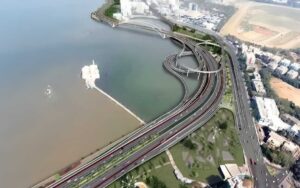

January 23, 2026: The Supreme Court has reiterated that land reclaimed for the Mumbai Coastal Road project, particularly in south Mumbai, must remain accessible to the public and cannot be diverted for residential or commercial development. The clarification came while the court was hearing a petition challenging the Brihanmumbai Municipal Corporation’s (BMC) move to issue an Expression of Interest (EoI) for appointing private agencies to undertake landscaping and maintenance of the reclaimed stretches.
During the proceedings, the bench referred to its earlier directions issued in late 2022, which had categorically prohibited any form of commercial or residential construction on the reclaimed land. The judges emphasised that the core objective of creating such land was to expand public open spaces and community amenities, a principle that continues to guide its use. The court underlined that only limited interventions connected to landscaping, upkeep, or essential infrastructure would be permissible, provided they do not compromise public access.
The petitioners had expressed concerns that the engagement of private entities, including those operating under corporate social responsibility (CSR) initiatives, could gradually lead to restricted access or indirect commercial exploitation of the land. Addressing these apprehensions, the court clarified that even facilities developed or maintained through CSR funding must ordinarily remain open for public use. Temporary restrictions would be allowed only in narrowly defined circumstances, such as during ongoing maintenance work or where safety considerations require limited access.
The Mumbai Coastal Road project has generated substantial reclaimed land beyond the main carriageway, sparking debate over how these newly created spaces should be utilised. With Mumbai already facing a severe shortage of open areas relative to its dense population, the future of this reclaimed land has drawn significant public attention.
By reaffirming its earlier stance, the Supreme Court has sought to ensure that reclaimed coastal land is preserved as a shared civic resource rather than converted into private or revenue-generating assets. The ruling reinforces the idea that large infrastructure projects in congested cities must deliver broader public benefits, particularly in the form of accessible open spaces that enhance urban livability.