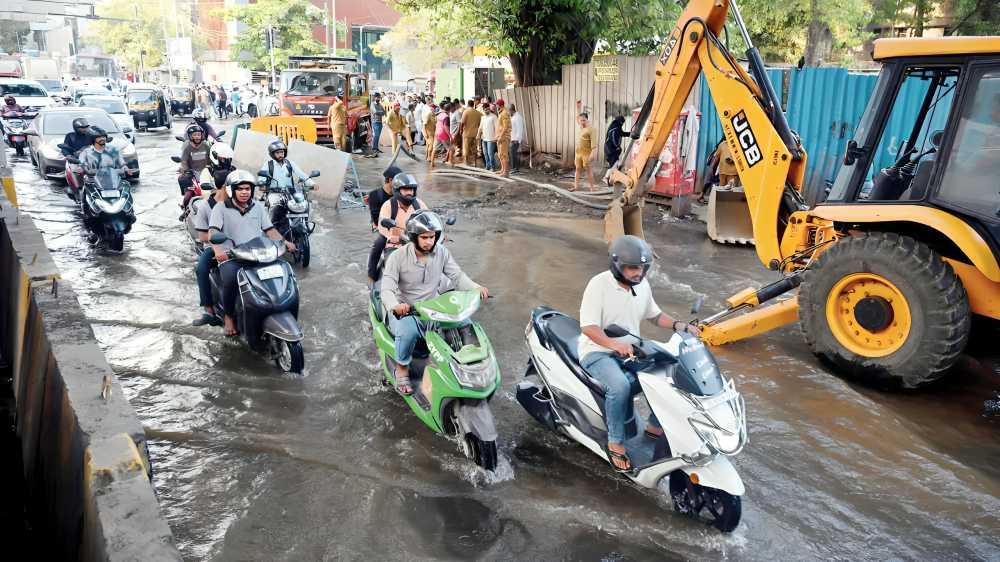

Mumbai is witnessing rising air pollution levels, largely driven by large-scale construction and infrastructure activities across the city. As of Thursday morning, the overall Air Quality Index (AQI) stood at 113 according to Aqi.in, placing the city’s air in the “poor” category. Several neighbourhoods, including Borivali East and West, Churi Wadi, Kandivali East, Louis Wadi, Malad West, Om Siddhivinayak Society, and Sarvodaya Nagar, were classified as “unhealthy,” while Mithchowki and Mirashi Nagar Vali recorded “severe” AQI levels above 200.
However, data from the Central Pollution Control Board indicated that Borivali East (67), Ghatkopar (88), Kandivali East (65), and Malad West (73) were in the “satisfactory” range, whereas Shivaji Nagar slipped to “moderate” at 101. The Indian Institute of Tropical Meteorology forecast that Mumbai’s air quality is likely to remain in the “moderate” category between February 26 and 27.
Environment Minister Pankaja Munde stated that no adverse health effects have been officially reported among children, senior citizens, or other vulnerable groups. Yet, Maharashtra health department data presented to the legislative assembly indicated that rising pollution is contributing to lung cancer, accounting for 57% of diagnosed cases.
In comparison, Delhi’s air quality remains far worse. The IITM reported an overall AQI of 201, while the CPCB noted “very poor” conditions at Anand Vihar (307), “poor” at Dwarka Sector 8 (214), and “moderate” at Aya Nagar (151). Several areas in Delhi recorded “hazardous” levels above 300, including Aya Nagar Extension, Jaunti, Mayur Vihar Station, and Pandav Nagar.
To tackle Mumbai’s pollution, Chief Minister Devendra Fadnavis instructed the Brihanmumbai Municipal Corporation to implement a real-time monitoring system using AI and IoT. MLC Anil Parab highlighted hotspots like Kherwadi in Bandra, blaming construction dust from ongoing projects.
Authorities have intensified enforcement: over 1,000 construction sites received stop-work notices for environmental violations, with 1,981 show-cause notices issued between October 2025 and January 2026. Nearly 88% of Mumbai’s active construction sites now use low-cost air quality sensors, supported by 126 water tankers and 25 misting machines covering 14,400 km of roads to reduce dust pollution.
Source: Hindustan Times