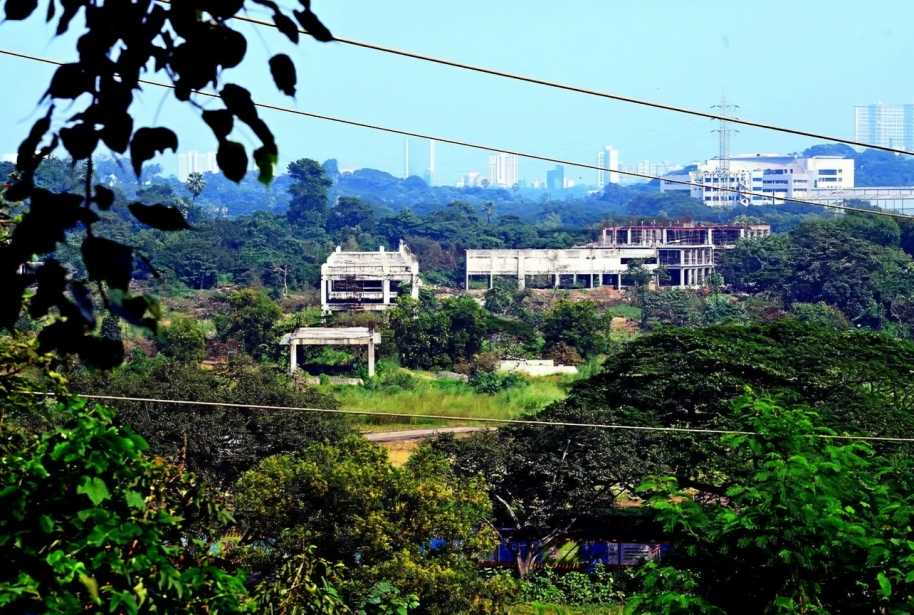

The Maharashtra government on Thursday told the Legislative Assembly that air pollution monitoring systems have been installed at most construction sites across Mumbai as part of efforts to address the city’s worsening air quality.
Responding to a question raised by Manisha Chaudhary during the ongoing Budget Session, Deputy Chief Minister Eknath Shinde said it was incorrect to suggest that the administration lacked information regarding compliance or enforcement related to the installation of air quality monitoring sensors at construction sites.
He stated that, following directions issued by the Bombay High Court on January 9 and April 29, 2025, installing air pollution monitoring devices along with LED display boards has been made mandatory for all ongoing construction projects.
According to Shinde, as of February 16, 2026, a total of 1,952 out of 2,224 construction sites in Mumbai had already installed these monitoring systems. In addition, authorities have introduced a Decision Support System (DSS) to track and analyse air quality data collected from these locations.
Steps to control construction dust
The Deputy Chief Minister also dismissed allegations that the government was neglecting pollution caused by construction activities. He said the Brihanmumbai Municipal Corporation is implementing the “Mumbai Air Pollution Mitigation Plan 2023” to tackle major pollution sources and reduce emission levels in the city.
The civic body issued detailed guidelines on October 25, 2023, outlining 27 measures that contractors, developers, construction professionals and civic officials must follow to control dust pollution. These guidelines were later revised on October 15, 2024, increasing the number of measures to 28.
The measures include installing sheet barricades around construction sites, covering work areas with green cloth or protective netting, carrying out regular water sprinkling to reduce dust, and ensuring scientific handling and transportation of debris. The rules also require the installation of air pollution monitoring equipment at project sites.
To ensure compliance, the BMC has formed departmental flying squads that conduct inspections and initiate action against violators.
Long-term measures to tackle pollution
Shinde further highlighted several long-term initiatives being implemented in coordination with government agencies and other stakeholders to improve Mumbai’s air quality.
These include upgrading road infrastructure, expanding public transport through metro networks and promoting sustainable urban mobility.
He informed the Assembly that 354 wood- and coal-based bakeries and crematorium furnaces within BMC limits have been converted to cleaner fuels such as pipeline natural gas or electricity.
The Brihanmumbai Electric Supply and Transport undertaking is also gradually introducing electric buses to reduce vehicular emissions.
Additionally, the government appointed the Automotive Research Association of India in December 2024 to identify pollution sources and update the emission inventory for the Mumbai Metropolitan Region.
Shinde said that in view of these ongoing initiatives, the question of delay in addressing air pollution in Mumbai does not arise.
Source: Mid-day