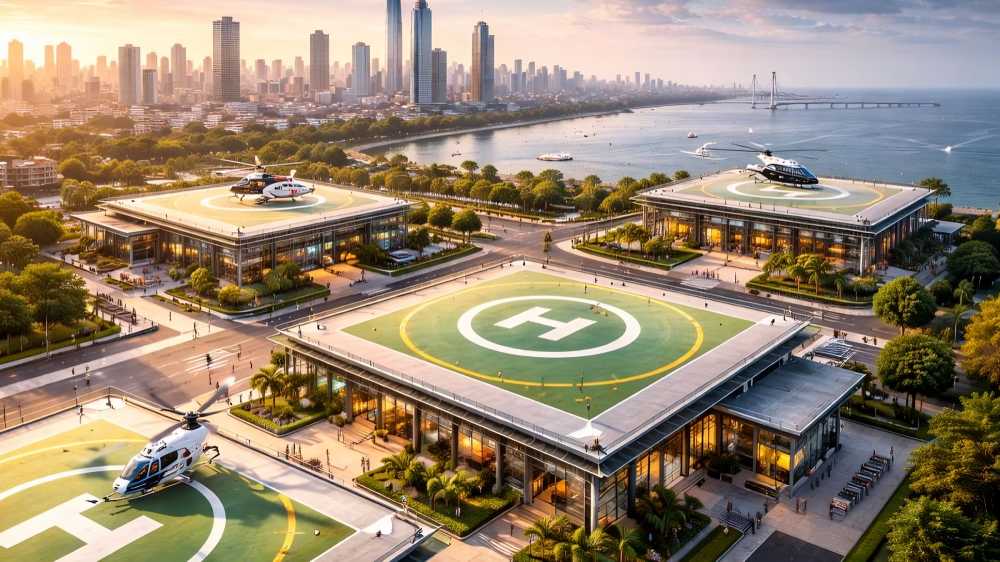

Mumbai is set to develop four new helipads over the next six years as part of efforts to build a future-ready, multi-modal transport network. The plan involves two helipads by the Brihanmumbai Municipal Corporation along the Mumbai Coastal Road Project and two more by the Mumbai Metropolitan Region Development Authority in the Bandra Kurla Complex.
The civic body has proposed one helipad at Charkop near the northbound stretch of the coastal road. Earlier, a tender was floated for a helipad at Worli along the southbound arm, which has been awarded to the Raymond Group. Officials noted that the Worli site was previously used as a jetty.
Authorities clarified that the primary purpose of these helipads will be to support emergency services such as air ambulances and evacuation operations during critical situations, rather than routine commercial use.
“These helipads are being constructed mainly to facilitate emergency services like air ambulance and evacuation work. In the next five years, Mumbai will see the emergence of high-speed corridors like the Coastal Road and Goregaon Mulund Link Road (GMLR). Therefore, our objective is to keep an option open for a multi-modal transit system by making way for helipads. We have chosen spots specifically near the coastal road to ensure that there is uninterrupted transit, as passengers can easily take the motor vehicle and access any part of the city after landing from helicopters,” a civic official said.
The helipads will be developed under a public-private partnership model, with private contractors responsible for construction and maintenance, and revenue shared with the authorities.
The Mumbai Metropolitan Region Development Authority is also progressing work on two helipads in BKC, with tenders issued last year and completion expected within five years.
Mumbai’s earlier attempts at building helipad infrastructure have seen limited success. A proposal to upgrade the heliport at the Mahalaxmi Racecourse did not materialise due to opposition, while several helipads atop high-rise buildings remain unused due to airspace constraints.
“Earlier, the old helipad at Mahalaxmi racecourse would serve as a common platform. However, with so many skyscrapers around, that place became a no-fly zone, and movements were restricted. In fact, so many buildings have defunct helipads on them because other high rises are adjoining their periphery, undermining the purpose of having a helipad,” an official said.
“Therefore, the advantage of these two new helipads that will adjoin the coastal road will be that since they are by the sea, there is no risk of buildings coming up and helicopters can fly in towards the mainland easily from the seaside without any restriction,” the official added.
Urban planners, however, have emphasised the need for a unified policy framework to regulate helipad usage across the city.
“For any global big city like New York or London, helipads atop buildings and open spaces are common. However, they are not restricted to private usage only, and they cater to everyone. Therefore, the administration must remember that the purpose of these helipads is about providing emergency services instead of catering to a select section of society,” architect Alan Abraham said.
Source: The Indian Express