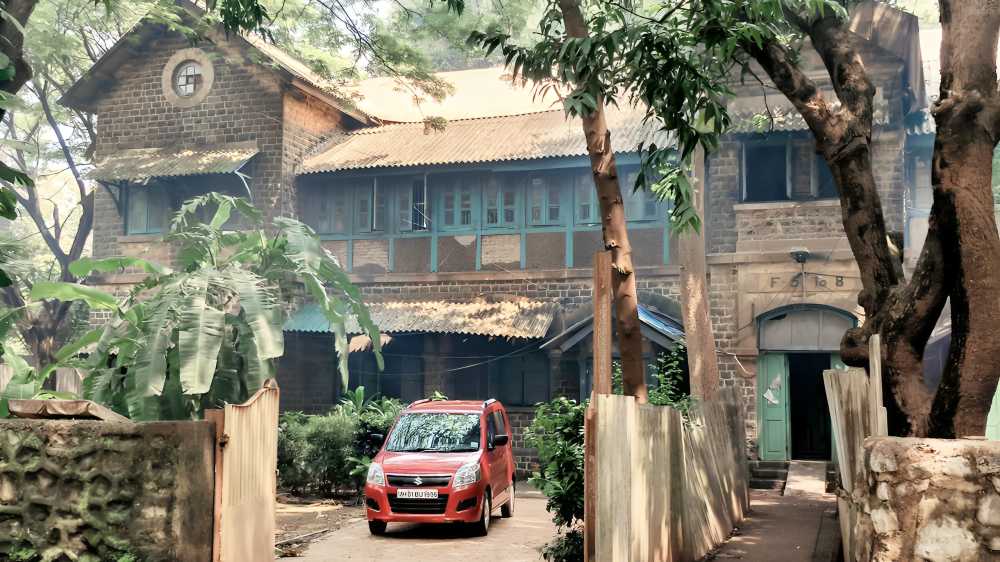

December 17, 2025: For more than a hundred years, Wenden Avenue Railway Colony in Matunga stood apart from Mumbai’s relentless pace. Shaded by dense tree cover and defined by stone bungalows, Nissen huts and winding internal roads, the enclave nurtured generations of Central and Western Railway families. That quiet rhythm has now been replaced by construction machinery, as the colony has been handed over for the Dharavi redevelopment project and demolition is underway.
The colony, named after Henry Charles Edward Wenden, Agent of the Great Indian Peninsula Railway in the early 1900s, once reflected both architectural elegance and strong community life. While the Western Railway section later saw concrete blocks, the Central Railway side retained its distinctive stone cottages and mushroom-shaped Nissen huts, many of which have now been dismantled.
Dr Shekhar Krishnan, historian and advisor to the BMC Heritage Conservation Cell, recalled the area’s unique setting and transition over time, saying, “My mother used to walk up and down this road to school every day from ‘BB Matunga’ to ‘GIP Matunga’ (WR and CR)… Now it’s gone forever.”
Former residents describe Wenden Avenue as an oasis. Retired Central Railway employee Samson Mathew, who lived there for decades, said, “It was once one of the most tranquil places in Mumbai… These memories now exist only in the mind. Time to move on, but Wenden Avenue will always stay with us.”
Author and former railway officer Sanjay Chandra also traced his early career to the colony, recalling his probationer days and modest hostel life. “The probationary officers’ hostel on the exotically named Wenden Avenue was our temporary home during our railway training in 1982,” he said, reflecting on friendships forged despite limited comforts.
Trade union leaders emphasise that Wenden Avenue was more than housing. Venu P Nair of the National Railway Mazdoor Union described it as a living institution built on solidarity, cultural life and shared struggle.
As demolition progresses, residents say the deepest loss is not just architectural heritage, but the disappearance of a rare township where dignity, community and history once coexisted.
Source: Mid-day