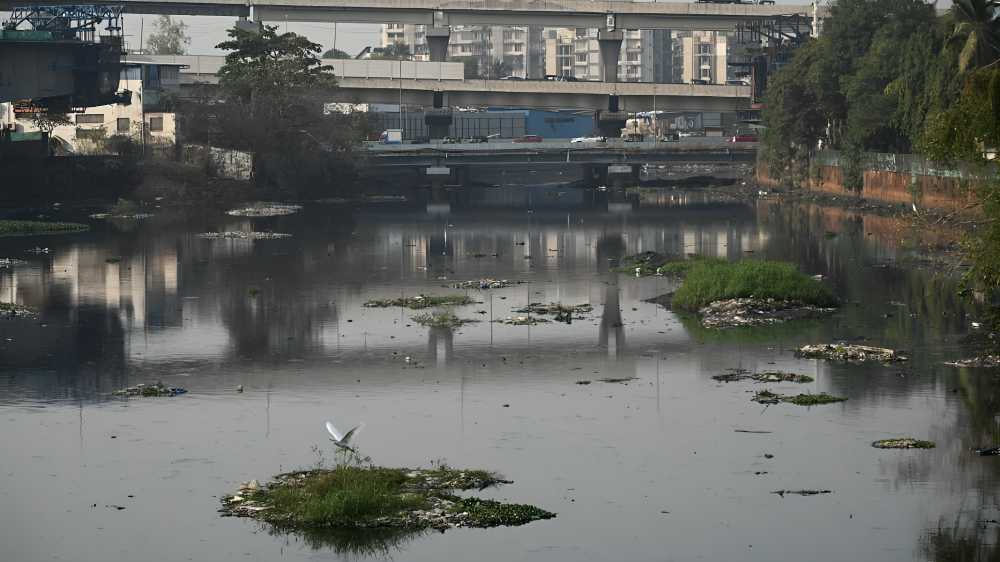

January 14, 2026: Over 18 years after the devastating 2005 floods that claimed more than 1,000 lives, Mumbai’s Mithi river continues to reflect the city’s ongoing struggle with urban infrastructure, governance, and pollution. Once a national symbol of vulnerability, the river remains choked with untreated sewage, industrial effluents, and debris, even as successive Brihanmumbai Municipal Corporation (BMC) administrations have pledged action. An investigation by The Indian Express highlights stalled projects, unspent funds, and deteriorating water quality as the city heads to long-delayed civic elections on January 15.
Records obtained under the Right to Information (RTI) Act reveal that over Rs 6,300 crore allocated for Mithi river-related projects remain largely unspent. Despite Rs 1,297 crore already spent on desilting and flood mitigation, untreated sewage of 309 million litres per day continues to flow into the river. Water Quality Index (WQI) data from the Maharashtra Pollution Control Board (MPCB) between 2017 and 2025 shows Mithi’s water quality fell into the “Bad to Very Bad” category for 65 months and “Bad” for another 16, while faecal coliform levels surged 2.5 times between 2009 and 2024, peaking at 540,000 units per 100 ml in 2023—216 times above CPCB limits. Biochemical oxygen demand (BOD), indicating organic pollution, reached 108 mg per litre, far exceeding the safe threshold of 3 mg.
The BMC has undertaken desilting and flood mitigation work, widening the river, constructing retaining walls, and installing drainage and sewage interceptors. “The desilting work has definitely increased the holding capacity of the river. It can now hold a greater volume of water, reducing the chances of flooding during high tide,” said Dr. Rakesh Kumar, former director of NEERI. Tuhin Banerji, a former NEERI scientist, added, “The administration needs to focus on treating wastewater entering the river through the drains lining it. This treatment should be carried out in a decentralised manner, at the point of origin of these drains.”
Key projects remain delayed or stalled. The Mithi River Quality Improvement and Pollution Control Project, initiated in 2017, has four packages, only one of which has been completed. Package 2, covering 10 km of sewage network and retaining walls, is now due for completion in March 2027. Package 3, involving floodgates at 18 outfalls, received approval only in December 2025, eight years after the project began. Package 4, a 6.8-km sewage diversion tunnel, has a revised deadline of December 2026. Another initiative, the Mithi River Rejuvenation Project, has yet to see any execution despite a Rs 35.87 crore consultancy study completed in 2024. Meanwhile, Rs 3,941 crore allocated under the river quality project and Rs 2,437 crore under the “Rejuvenation of Rivers” head remain unspent.
The human cost of inaction is significant. Residents along the river, particularly in Kurla, Dharavi, and Saki Naka, face high exposure to faecal contamination, risking fever, diarrhoea, and skin infections, especially among children and the elderly. “High carbon contamination increases bacterial activity, which depletes dissolved oxygen essential for aquatic life, thereby threatening marine ecosystems,” said Dr. Kumar.
Despite annual allocations for desilting rising from Rs 20–30 crore (2006–2020) to Rs 90 crore for 2025–26, pollution persists. The Mithi, originating from Vihar and Powai lakes and flowing through Andheri and BKC before emptying into Mahim creek, is now listed by the CPCB as one of India’s three most contaminated rivers, alongside stretches of the Cauvery and Swarnarekha.
As Mumbai heads to civic polls, the river’s condition is a stark reminder that flood mitigation alone is insufficient. While infrastructure improvements have helped prevent another disaster on the scale of 2005, experts argue that only systematic sewage treatment, pollution control, and timely project execution can restore the river’s ecological and civic health, safeguarding both human lives and the city’s resilience.
Source: The Indian Express