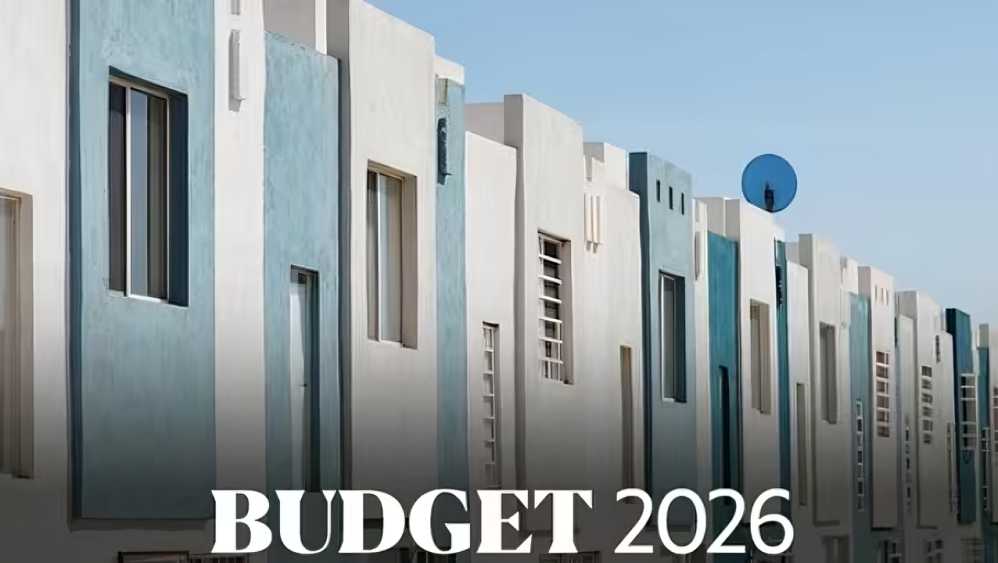

As Finance Minister Nirmala Sitharaman presents the Union Budget 2026 today, the real estate sector is pressing for policy measures that can improve housing affordability, expand rental housing, and create a more balanced regulatory environment. Industry bodies and homebuyer groups have outlined five key demands, ranging from revisiting the definition of affordable housing to strengthening accountability for developers.
1) Reworking the definition of affordable housing
A central demand from developers is a revision of the existing definition of affordable housing, which has remained unchanged since 2017. At present, unit sizes are capped at 60 sq metres in metropolitan areas and 90 sq metres in non-metros, with a maximum value of Rs 45 lakh. According to CREDAI, the apex body representing real estate developers, these limits no longer reflect current land prices and construction costs. The body has also highlighted the challenge of multiple definitions across schemes such as PMAY, RBI, NHB, and RERA, which adds to compliance complexity.
CREDAI has proposed increasing carpet area limits to 90 sq metres in metros and 120 sq metres in non-metros, removing the price cap, and aligning the definition with a unified list of infrastructure sub-sectors. It believes an area-based approach would help expand viable housing supply in cities, simplify compliance, and support employment and economic activity. NAREDCO has echoed this view, recommending that homes priced up to Rs 75–80 lakh be treated as affordable instead of the current Rs 45 lakh threshold.
2) Greater emphasis on rental housing
Another key expectation is a stronger policy focus on rental housing. CREDAI has called for the launch of a national rental housing mission, citing rapid urbanisation and rising migration that have left the organised rental housing segment underdeveloped.
“CREDAI recommends establishing a National Rental Housing Mission to develop large-scale affordable rental stock in tier-1 and tier-2 cities through fiscal incentives for developers, tax relief for tenants, and institutional participation. This initiative will formalise the rental market, curb informal settlements, support workforce mobility, and create a sustainable investment class without significant budgetary outlay,” it had said in a statement last week.
NAREDCO has also urged incentives for developers, noting that rental yields in housing remain low at 1–3%, making such projects commercially unattractive without policy support.
3) Revisiting housing loan interest deductions
Industry bodies have also sought a revision in the Rs 2 lakh cap on housing loan interest deductions, which has not changed in over a decade. With higher property prices, loan sizes, and interest rates, the benefit has become less meaningful for middle-income buyers, particularly in urban markets where annual interest outgo can exceed Rs 4–6 lakh.
CREDAI has suggested removing the cap for the first self-occupied home and extending the benefit to the new tax regime. NAREDCO, meanwhile, has recommended raising the deduction limit to Rs 5 lakh and granting industry status to the sector to support growth.
4) Infrastructure status for senior living
With India’s ageing population driving demand for senior living, developers in this segment have sought infrastructure status to improve access to long-term and affordable financing. They have also called for pension-linked, tax-efficient products that can convert retirement savings into predictable monthly payouts, along with a dedicated nodal agency to bring policy coherence across states.
5) Stronger accountability for developers
Homebuyers have emphasised the need for balanced accountability. The Forum for People’s Collective Efforts has argued that just as buyers lose interest subsidies for defaults, promoters should face penalties for delays and non-delivery. It has proposed adding EMIs collected during default periods back to promoters’ profits as a deterrent. “The underlying principle must be unequivocal: a promoter’s promise to an allottee is sacrosanct and non-negotiable. Balanced accountability on both sides is essential to restore trust in the real estate sector and enable it to contribute meaningfully to the country’s economic growth,” it said.
Source: Hindustan Times