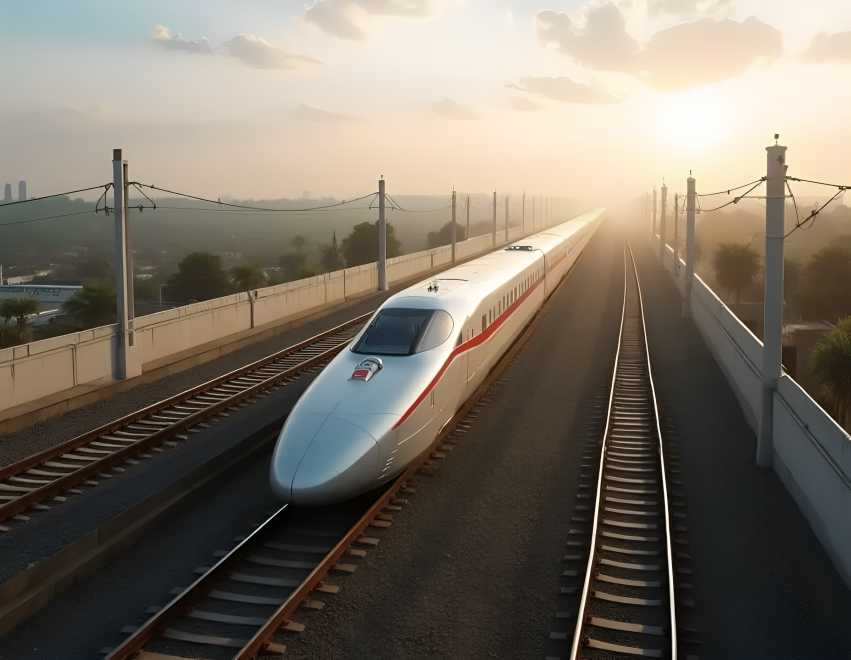

India’s first high-speed rail corridor between Mumbai and Ahmedabad is progressing steadily, evolving beyond a transport link into a platform for engineering development, technology adoption and long-term infrastructure planning.
Railway officials have confirmed that construction on the 508-km corridor is advancing across Gujarat and Maharashtra following the resolution of land acquisition issues. The project, being implemented with technical and financial collaboration from Japan, has secured the required land and statutory approvals.
In Gujarat, work has progressed across multiple sections, with foundations and piers completed along large stretches. Girder casting, launching and track bed construction are underway. In Maharashtra, structural development continues, including the underground station at Bandra Kurla Complex and the under-sea tunnel segment, where tunnelling has commenced and certain portions are already complete.
Of the 12 proposed stations, foundation work is largely complete in Gujarat, while construction continues at key Maharashtra locations. Seventeen river bridges have been completed, and major river crossings are at advanced stages. Depots at Thane, Surat and Sabarmati are being developed to support operations.
The project is also contributing to skill development and domestic manufacturing. Long-span steel truss girders and full-span viaduct launching systems are being produced in India. Slab track materials and specialised equipment are increasingly sourced locally. Around 1,000 engineers and workers have been trained in Japanese high-speed rail systems, and a dedicated training facility has been set up in Surat.
Safety features include seismic-resistant structures, dampers and stoppers on viaducts, and a planned earthquake early warning system. Stations incorporate anti-vibration design and energy-efficient elements.
Expenditure has crossed ₹86,000 crore. Officials state that viability assessments consider passenger demand, regional integration and travel time savings, with ticket pricing expected to align with air and premium rail services. The corridor is positioned as a reference model for future high-speed rail projects in India.
Source: Urban Acres