
As affordable homes disappear, Mumbai risks locking its middle class out of homeownership altogether. Without viable entry points, young professionals and first-time buyers are steadily losing their chance to build roots and long-term wealth in the city.
For decades, the 1BHK flat represented the first rung of Mumbai’s property ladder. It was the classic first home; compact, imperfect, usually located in the suburbs, yet within reach. Today, that rung is quietly disappearing. Developers across the Mumbai Metropolitan Region (MMR) are steadily shifting away from compact homes and toward larger 2BHK and 3BHK units, even in areas that historically catered to entry-level buyers. The implications go far beyond market preferences: they touch the future of urban mobility, workforce stability and middle-class aspiration.
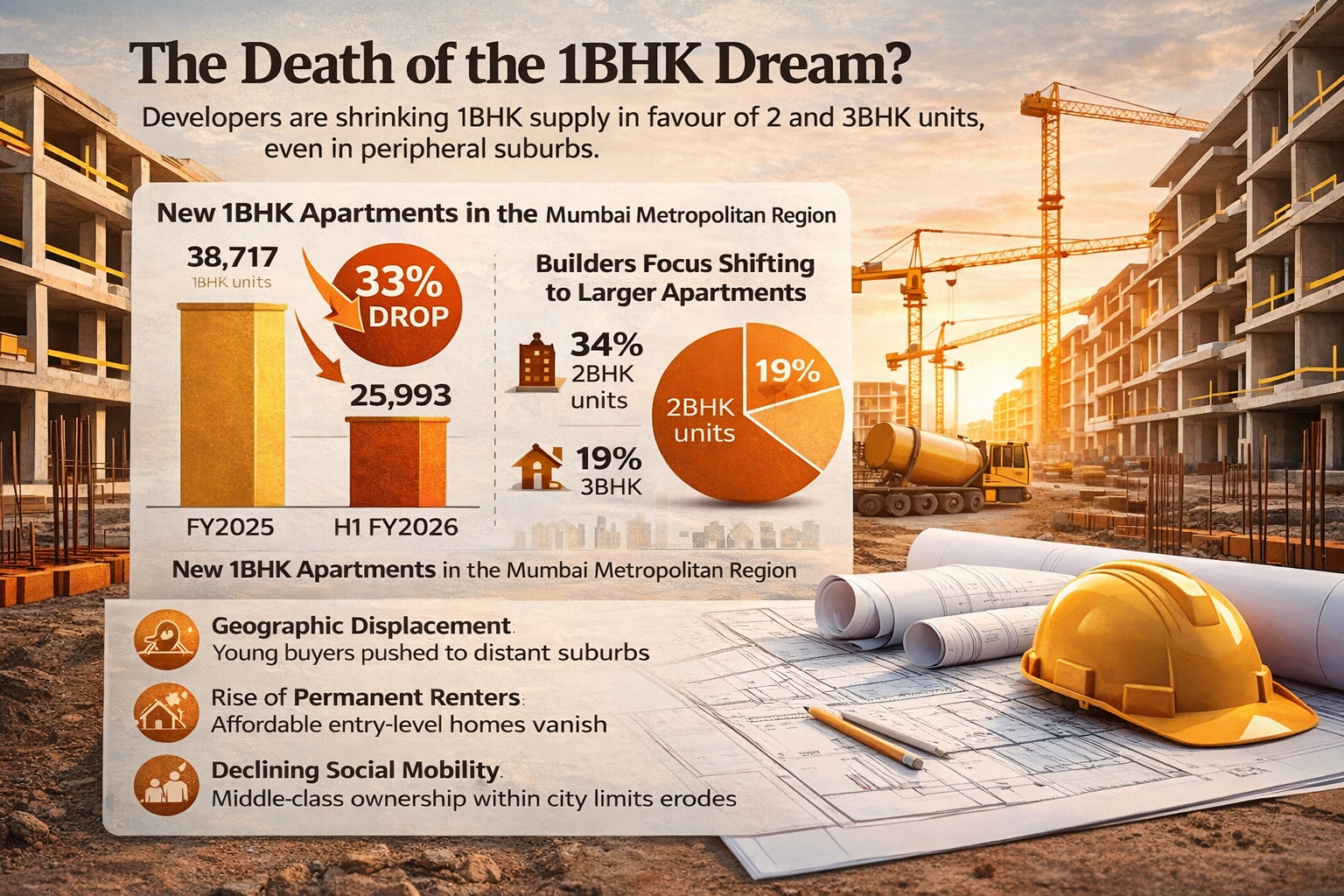
The numbers reveal a structural shift underway. The supply of 1BHK homes in Mumbai has sharply declined in recent years, with industry data showing a significant drop in new launches and sales across the segment. In FY2025, nearly 38,717 one-bedroom units were added across the MMR, but only about 25,993 were introduced in the first half of FY2026, indicating a clear slowdown in supply. Meanwhile, developers are increasingly favouring larger configurations. In 2025, about 34% of new launches were 2BHK units and nearly 19% were 3BHK homes, reflecting a decisive shift toward bigger apartments.
This transition is not accidental. It is economic. Mumbai’s real estate market is defined by some of the highest land prices in the world, combined with rising construction costs, regulatory compliance expenses and expensive financing. When land is scarce and development costs are high, developers gravitate toward products that maximise revenue per square foot. Larger homes offer precisely that.
The broader national trend supports this shift. Developers across India’s major cities are prioritising premium housing as affluent buyers dominate demand. In fact, luxury homes priced above Rs 1 crore now account for a rapidly increasing share of residential sales, while demand for homes priced below Rs 1 crore has fallen sharply.
In simple terms, the economics of building affordable housing in India’s most expensive city no longer works.
Yet the disappearance of the 1BHK is not merely a supply-side story; it is also about who gets to live in the city. Mumbai’s workforce, young professionals, migrants, first-time buyers, historically relied on compact homes to establish a foothold in the city. When that option disappears, the consequences ripple outward.
One immediate impact is geographic displacement. Without affordable entry-level homes in the city, buyers are pushed farther into peripheral suburbs or satellite cities such as Palghar, Karjat or beyond the traditional metropolitan boundary. These increases commute times, strains infrastructure and weakens the economic efficiency of the city itself.
Another consequence is the rise of a permanent renter class. When ownership becomes unattainable, households remain in the rental market longer. Analysts already warn that rising home prices combined with shrinking affordable supply are forcing many urban residents into long-term renting. While renting is not inherently problematic, the shift can deepen wealth inequality in a country where property ownership remains a key driver of household asset creation.
The most worrying impact, however, may be social. Housing is not merely shelter; it is the foundation of middle-class stability. When the entry point to ownership disappears, the ladder of upward mobility becomes harder to climb.
Mumbai’s affordability indicators already reflect this strain. The city’s price-to-income ratio has climbed to around 15, three times the level generally considered affordable, while EMIs now consume nearly half of a typical household’s income. In such an environment, expecting young professionals to leap directly into Rs 1.5 to 2 crore homes is unrealistic.
The market alone is unlikely to correct this imbalance. Developers respond to economics, not sentiment. If land and construction costs continue to escalate, builders will naturally prioritise higher-margin housing segments.
That means policy intervention may become unavoidable. Incentives for smaller units, faster approvals for affordable housing projects, higher Floor Space Index (FSI) utilisation and targeted tax benefits could help restore viability to entry-level housing. Without such measures, the private market will continue to drift toward premium housing.