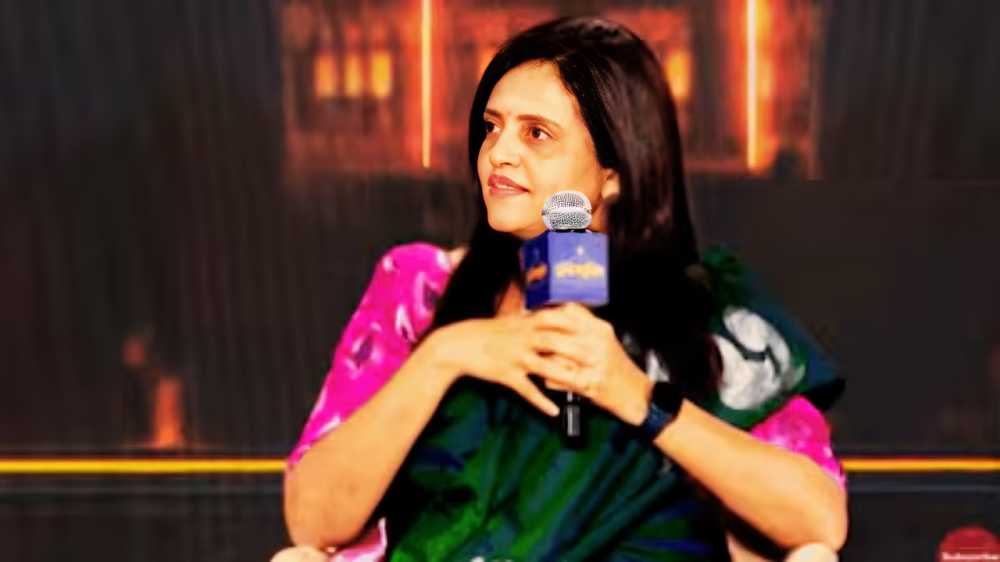

India’s infrastructure development over the past decade has been about far more than highways, bridges and transit networks. According to Brihanmumbai Municipal Corporation (BMC) Commissioner Ashwini Bhide, it represents a fundamental shift in the way cities are planned, governed and equipped for the future.
Widely known for her role in delivering key urban transport projects, Bhide recently became the first woman to head the BMC. She highlighted how rapid urbanisation is reshaping policy priorities and placing cities at the centre of India’s growth story.
Pointing to Maharashtra’s evolving demographic landscape, Bhide said urban infrastructure must expand aggressively to accommodate future population growth.
“Even if you take Maharashtra as part of that Viksit Bharat journey, Maharashtra today is more than 50% urbanised. But we are seeing that by 2047, we will almost be 75% urbanised,” Bhide says. “That is the kind of vision which we have. If that is the case and so much of population is going to get concentrated in urban areas, in the city centres, then the cities need to be equipped to take care of that population load, make those cities liveable.”
She stressed that modern urban mobility requires seamless integration across transport modes rather than isolated infrastructure projects. From suburban rail and metro networks to feeder services and digital mobility platforms, the focus is increasingly on creating a commuter-centric ecosystem.
“I feel it’s a very, very satisfying experience for me when all the dots are connected. And the commuter is kept at the centre of the discussion. And the ease of commuting for commuter by every means is being focused,” Bhide told News18.
Bhide also described infrastructure as a critical driver of economic growth, noting its impact on businesses, employment and long-term development.
“The infrastructure plays a dual role. First of all, it brings so much of money in the economy. It boosts local businesses, it boosts many equipment suppliers, then labour market and at the same time, it builds the infrastructure which is needed for the flight of the economy,” says the BMC commissioner.
“And India, as we are moving ahead with our development plans, infrastructure is a major contributor of the economy. And I think this special boost and encouragement to build the infrastructure which the country deserves has been remarkable. It has achieved remarkable success too,” she adds.
On overcoming project delays, Bhide credited high-level monitoring mechanisms such as PM Gati Shakti and Pragati reviews for accelerating decision-making and improving inter-agency coordination.
“Earlier we used to do it, but we had to literally fight for each and every component of it. And then sometimes we used to get tired also. But now since there is a very, very stringent monitoring mechanism at different levels, including a war room at Honourable Chief Minister’s level and the war room at Honourable Prime Minister’s level because the Pragati review is kind of that war room where all the inter-agency issues are documented. They are brought together, put on a timeline and a calendar, and then they are monitored at the highest level,” Bhide says.
“The message which strongly goes to various agencies who are part of that process, being the regulatory authority, the message is very clear that they have to look at those proposals and take their quick decisions. If for some reason one particular approval cannot be given, then some alternative has to be found out. So, everybody is on their toes now,” she adds.
As BMC chief, Bhide said future urban development must prioritise inclusivity, climate resilience and accessibility.
“Every activity of ours needs to be seen through the lens of gender. Like we are looking at things from the lens of climate change because that is the new reality. Similarly, we have to focus on the inclusivity aspect of every service which BMC provides, every project which BMC does, every infrastructure which BMC provides, and from that perspective I think we need to sensitise our own people,” she says.
Source: News18