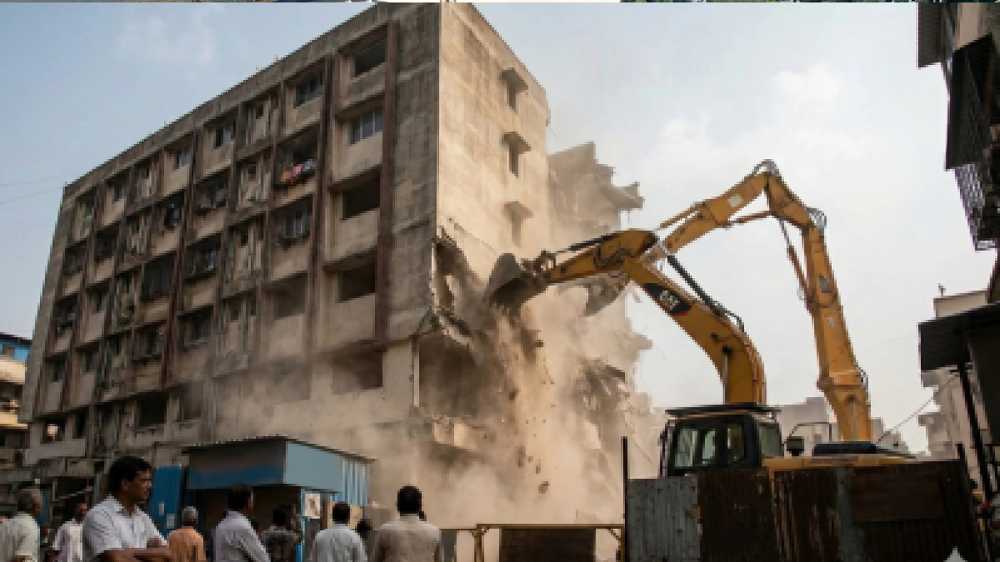

The Bombay High Court has raised concerns over alleged political interference in action against illegal constructions in Navi Mumbai and questioned how external pressure could obstruct demolition drives conducted by civic authorities.
During the hearing of a contempt petition related to more than 4,000 unauthorised buildings in Navi Mumbai, the court was informed that demolition action against illegal structures within the Navi Mumbai Municipal Corporation (NMMC) limits is often delayed due to interference from local political leaders.
Taking note of the submissions, the court questioned, “How can political leaders interfere in the demolition action of the municipality?”
The civic body submitted the names of seven officials allegedly responsible for allowing illegal constructions and informed the court that disciplinary action would be initiated against them. However, the court observed that while action against these officials was necessary, accountability should also extend to developers who created such unauthorised structures.
The court asked what action had been taken against developers who were responsible for initiating illegal projects and directed the Navi Mumbai Municipal Corporation to clarify its position on the matter.
The court also sought clarity from both NMMC and the City and Industrial Development Corporation (CIDCO) regarding coordination between the two agencies. While NMMC is responsible for taking action against illegal buildings, CIDCO owns several original plots on which such constructions have come up.
During the hearing, the court was informed that water supply to some unauthorised buildings that had received notices was disconnected. However, sewage connections had not been blocked as the civic body said it could lead to foul odour and sanitation issues.
The court expressed dissatisfaction with the approach, observing that merely cutting water supply may not force residents to vacate such buildings as alternative arrangements could be made.
Earlier, the municipal corporation had claimed that officials faced political pressure while attempting to take action against illegal structures. When the court asked whether the civic body wanted to place the allegation formally on record, officials expressed reluctance.
However, the petitioner supported the claim and informed the court that demolition drives were often affected due to pressure from local political leaders and ministers.
The petitioner also highlighted that illegal construction activity was continuing, with around 30 buildings allegedly under construction in Airoli. The court directed that photographs and additional details of these structures be submitted to the municipal corporation, following which appropriate action should be initiated.
Source: Loksatta