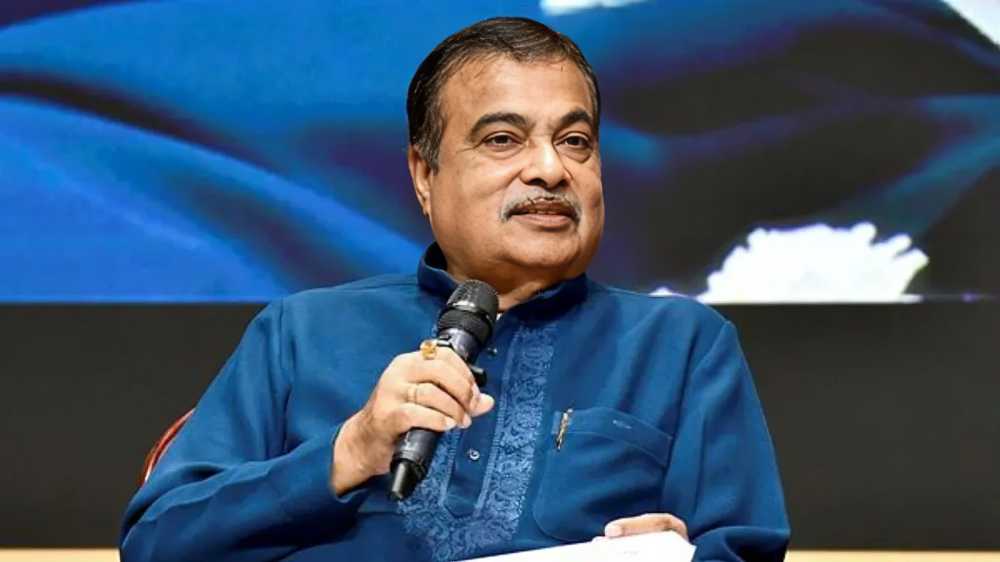

Mumbai’s persistent traffic congestion recently affected even Union Road Transport and Highways Minister Nitin Gadkari, who was delayed by nearly an hour while travelling from Worli to an event in the city. The experience prompted him to argue that Mumbai needs newer, technology-led approaches to expand road capacity within its limited urban space.
Speaking at the 22nd Indo-American Corporate Excellence Awards on September 12, Gadkari said, “Today I got late by an hour to reach here for this programme, because I got stuck in the traffic from Worli to this hotel. It took me one extra hour.”
Gadkari Looks Back at Mumbai’s Road Projects
Gadkari also reflected on his tenure as Maharashtra’s Public Works Minister from 1995 to 2000, when several major transport projects were developed across the state.
He said, “But that is actually me paying for my mistake. From 1995–2000, I got a chance to construct 55 flyovers, the Bandra-Worli Sea Link and the Mumbai-Pune Expressway, but at that time this technology was not available,” he said.
According to Gadkari, the infrastructure built decades ago was planned for significantly lower traffic levels. Mumbai has since grown substantially, with intense daily movement between South Mumbai, the western suburbs, Thane and Navi Mumbai.
Multi-Level Flyovers Proposed
Gadkari said he had suggested to Maharashtra Chief Minister Devendra Fadnavis that some existing flyovers could eventually be replaced with structures using newer construction technologies.
He also said India has acquired technology from Malaysia that could allow multiple flyover levels to be built on a single set of pillars. Such an approach could potentially increase road capacity vertically without requiring large amounts of additional land.
For Mumbai, where widening roads is often difficult because of dense development and limited space, multi-level infrastructure could offer an alternative to conventional road expansion.
More Road Space Within Existing Footprints
The minister’s comments underline a broader challenge facing Mumbai: traffic growth is putting pressure on infrastructure that was designed for an earlier era.
Flyovers and major road links that once reduced bottlenecks can now become congested themselves as vehicle volumes rise. Increasing road capacity therefore requires more than simply adding individual flyovers; authorities may need to rethink how available urban space is used.
Rs 50,000-Crore Plan for Pune
Gadkari also referred to a proposed Rs 50,000-crore infrastructure programme for Pune, reflecting a wider push towards technology-intensive transport solutions in rapidly growing cities.
For Mumbai, his latest remarks highlight the need to combine existing infrastructure with newer engineering methods, better traffic management and technology.
The objective, increasingly, is not just to construct more roads but to create greater mobility within a city where horizontal expansion is severely constrained.
As Mumbai continues to attract residents, businesses and investment, the pressure on its road network is unlikely to disappear. Gadkari’s proposal for multi-level structures suggests that the next generation of urban infrastructure may have to build upward as much as outward.
Source: Economic Times