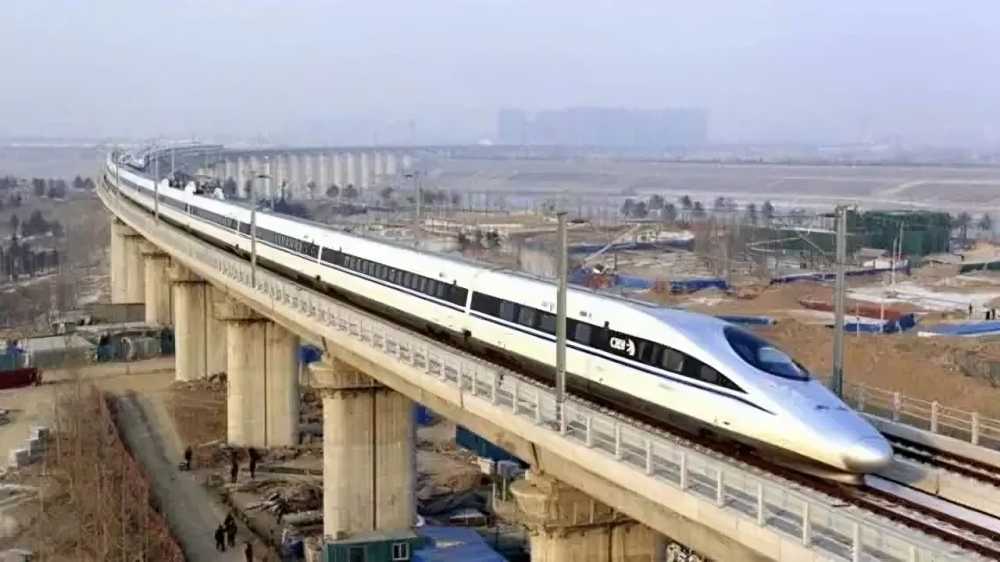

The Mumbai-Ahmedabad High-Speed Rail (MAHSR) corridor is introducing movable-crossing turnouts, also known as swing-nose crossings, for the first time on India’s railway network. The technology is being deployed by the National High Speed Rail Corporation Limited (NHSRCL) to support train operations at speeds of up to 320 km/h.
Unlike conventional turnouts that use a fixed crossing with a gap, movable crossings shift into position along with the switch rails. This creates a continuous rail surface for train wheels, reducing the impact, vibration and wear that can occur when trains pass through fixed crossings at high speeds.
Each high-speed turnout will use two separate point machines. One controls and locks the switch rails, while the other operates and secures the movable crossing nose. The signalling and interlocking system will permit a train to pass only after both machines confirm that the components are correctly positioned and locked.
Additional detection mechanisms will independently verify the position and locking of the switch rails and crossing nose, allowing the system to meet the precision requirements associated with high-speed rail operations.
The technology will be used across the 508-km MAHSR corridor, which includes 352 km across Gujarat and Dadra & Nagar Haveli and 156 km in Maharashtra. The route will connect Mumbai with Thane, Virar, Boisar, Vapi, Bilimora, Surat, Bharuch, Vadodara, Anand, Ahmedabad and Sabarmati.
The first operational section, between Surat and Bilimora, is targeted for August 15, 2027, while the entire corridor is planned for completion by the end of 2029.
The project’s progress also has implications for real estate markets along the route. Thane, Virar and Boisar are among the locations being watched for improved connectivity, although individual property prices will continue to depend on factors such as local infrastructure, supply and demand.
For investors, the movable-turnout technology represents a technical milestone rather than a direct property-market catalyst. It demonstrates that the corridor is being engineered around its stated high-speed specifications, while construction timelines and other project risks remain relevant considerations.
Overall, the technology marks an important engineering development for Indian railways and forms part of the infrastructure being created for the country’s first high-speed rail corridor.
Source: Magic Bricks
Pic Credit: Financial Express