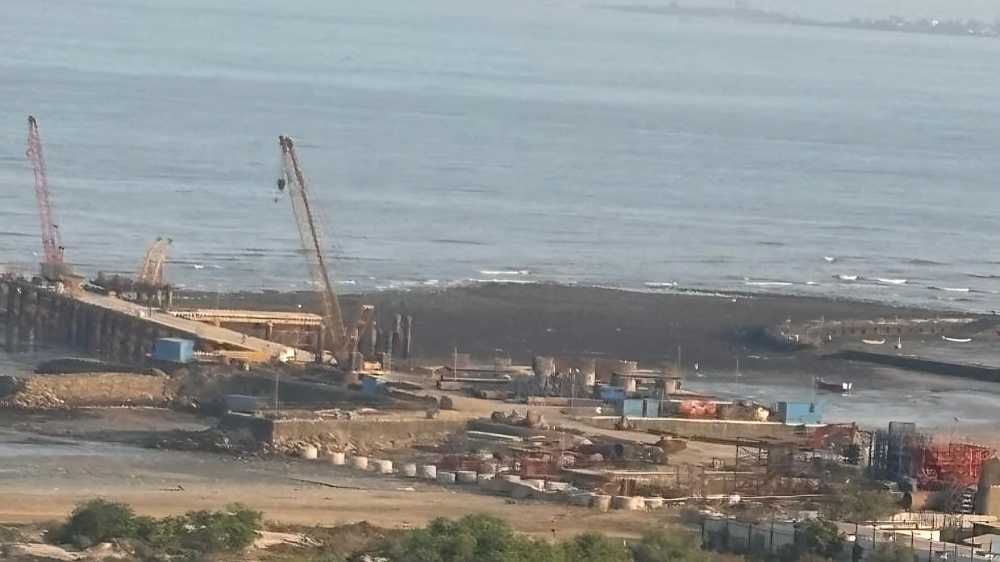

Work on the Versova-Bandra Sea Link (VBSL) in Mumbai has progressed with the fabrication of four specialised orthotropic steel deck (OSD) structures commencing in China. The Maharashtra State Road Development Corporation (MSRDC) has appointed specialised Chinese agencies to undertake this technically demanding work, with the installation of the structures planned before the 2027 monsoon.
The decision to source expertise from China is aimed at ensuring precision in manufacturing components required for construction in challenging open-sea conditions. Meanwhile, the steel superstructures for the Carter Road and Versova connectors are being manufactured in India through specialised agencies.
Unlike the Mumbai Trans Harbour Link (MTHL), which was largely constructed in relatively protected creek waters, the VBSL involves extensive marine construction in rough and exposed sea conditions. Officials have highlighted that these conditions make construction and transportation of heavy components more complicated.
Marine construction activities are generally restricted to the winter and summer months, as work comes to a halt during the monsoon because of unfavourable sea conditions. Given these operational challenges and the specialised engineering involved, the project, initially targeted for completion by May 2028, could require an extension of a few months.
Orthotropic steel deck technology offers advantages over conventional bridge construction methods, including reduced structural weight and greater strength compared with traditional concrete or composite girder structures.
The main sea link features a 300-metre cable-stayed section with a 150-metre navigational span, along with balanced cantilever bridges measuring 223 metres. The project also incorporates four OSD structures with 120-metre navigational spans, using box-girder and bow-string arch configurations.
Additionally, the Juhu connector will feature a 240-metre cable-stayed bridge supported by a central pylon. The Versova connector will include a cable-stayed structure with a 120-metre clear span, designed to minimise the removal of mangroves.
The specialised fabrication work marks an important step in advancing the sea link’s complex engineering components.
Source: The Free Press Journal