Mumbai’s business hubs may be shifting. With new roads, bridges, and the upcoming international airport, Navi Mumbai is emerging as more than a residential suburb and could soon host major corporate headquarters.
But a quiet shift may now be underway across the harbour. With large-scale infrastructure projects nearing completion, Navi Mumbai is increasingly being viewed not merely as a residential extension of Mumbai, but as a potential commercial nerve centre in its own right.
At the heart of this transformation lies the upcoming Navi Mumbai International Airport (NMIA). Once fully operational, the airport is expected to dramatically alter the economic gravity of the region. For corporations that rely heavily on global connectivity, proximity to an international airport is often a decisive factor in choosing office locations. Several large parcels of land around the airport influence zone are already being earmarked for commercial and logistics developments.
Connectivity is further being reshaped by the recently inaugurated Mumbai Trans Harbour Link (MTHL), officially named the Atal Bihari Vajpayee Sewri–Nhava Sheva (Atal Setu). Spanning over 21 kilometres, the bridge has significantly reduced travel time between South Mumbai and Navi Mumbai, strengthening the case for businesses to consider office locations across the harbour.
Infrastructure-led urban shifts are not new to global cities. When connectivity improves and land becomes scarce in traditional business districts, corporations begin exploring emerging hubs that offer larger development parcels and lower costs. Navi Mumbai fits this template almost perfectly.
Commercial real estate data reflects this growing interest. According to property consultancy Knight Frank, the Mumbai Metropolitan Region (MMR) recorded strong office leasing activity in 2023 and 2024, with emerging micro-markets gaining traction as companies seek cost-effective alternatives to central districts. Similarly, research by JLL notes that peripheral business districts are attracting corporates due to improved infrastructure and the availability of large-format office developments.
Cost is another powerful factor. Office rentals in established commercial districts like BKC or Lower Parel remain among the highest in India. In contrast, office space in Navi Mumbai can be significantly more affordable while still offering modern infrastructure, planned urban layouts and better parking availability. For companies planning large campuses or back-office operations, the financial advantage is considerable.
Yet the question remains: could Navi Mumbai truly evolve into the next headquarter city?
Several conditions would need to align for that to happen. Beyond infrastructure, corporations typically prefer business ecosystems where talent, financial services, hospitality and transport networks coexist. Established districts such as BKC benefit from dense clusters of banks, law firms, consultants and high-end hotels, an ecosystem built over decades.
Navi Mumbai is still developing that ecosystem. However, the combination of planned urban design, improving connectivity and proximity to the new airport could accelerate this transition.
Legacy hubs like Nariman Point have already experienced cycles of decline and reinvention over the past two decades as businesses migrated to newer districts like BKC. A similar decentralisation could occur again, with corporate functions gradually spreading across the wider metropolitan region rather than remaining concentrated in a few historic clusters. Such a shift would not necessarily weaken Mumbai’s economy. Instead, it could reshape it into a more polycentric metropolitan structure, where multiple business hubs coexist and complement each other. In many global cities, from London to New York, commercial activity is no longer confined to a single central district. Instead, it spreads across several interconnected hubs that specialise in different sectors and functions.
The real question, therefore, is not whether Navi Mumbai will replace Mumbai’s legacy business districts, but whether it will become the city’s next major economic node.
If infrastructure continues to deliver on its promise, the answer may well be yes. And if that happens, the skyline across the harbour could soon host not just residential towers, but the headquarters of India’s next generation of corporations.
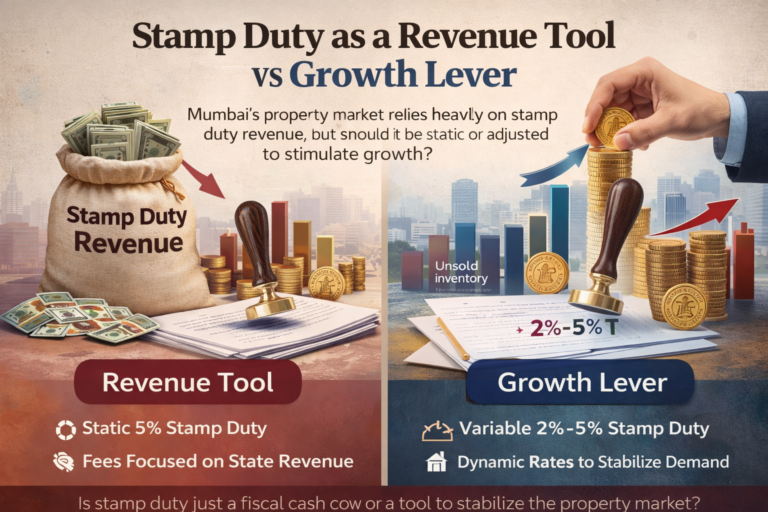
If stamp duty remains merely a fiscal cash cow, the property market will continue to move in volatile cycles. But used strategically,…
Learn moreIf stamp duty remains merely a fiscal cash cow, the property market will continue to move in volatile cycles. But used strategically,…
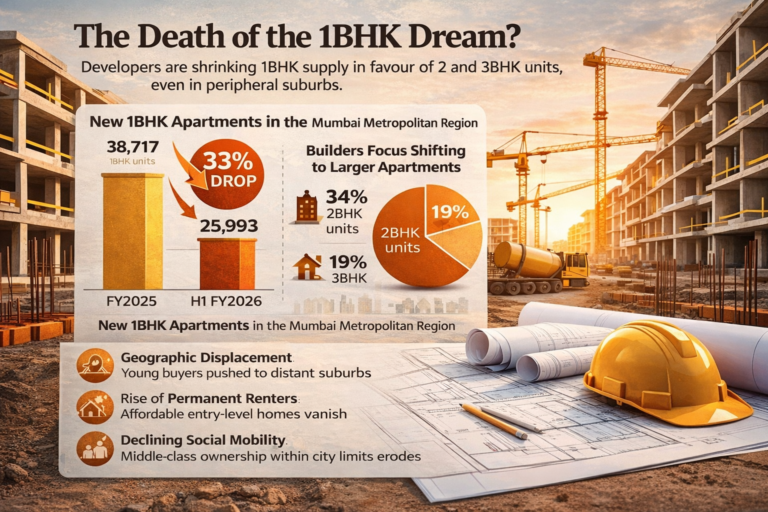
Learn moreAs affordable homes disappear, Mumbai risks locking its middle class out of homeownership altogether. Without viable entry points, young professionals and first-time…
Learn moreIn most global cities, property transactions are governed primarily by regulators, developers, and financial institutions. In Mumbai, however, the most decisive authority…

Learn more