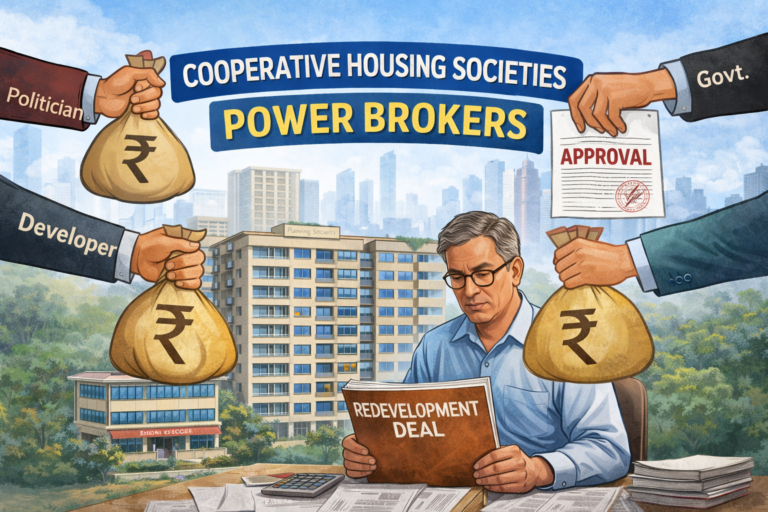
In most global cities, property transactions are governed primarily by regulators, developers, and financial institutions. In Mumbai, however, the most decisive authority in many real estate decisions is often the cooperative housing society itself.
Mumbai’s cooperative housing ecosystem is enormous. Maharashtra has more than 1 lakh cooperative housing societies, a large concentration of which is in the Mumbai Metropolitan Region (MMR). Yet around 50% of these societies still do not have a conveyance deed transferring land ownership from developers to residents, a structural gap that complicates redevelopment and legal clarity.
Redevelopment illustrates the extraordinary influence of housing societies. In Mumbai alone, about 10,000 buildings older than 30 years are potential candidates for redevelopment, making societies key stakeholders in unlocking the city’s future housing supply. Legally, redevelopment requires majority consent, typically at least 51% of members, after which dissenting residents cannot stall the project if procedures are followed. Yet in practice, redevelopment often turns into prolonged internal battles involving competing developer offers, opaque negotiations, and factional politics within societies.
Courts have repeatedly reinforced the autonomy of societies in such matters. A recent ruling clarified that government registrars cannot interfere in redevelopment decisions taken by a society’s general body, effectively returning control to residents themselves. While this strengthens cooperative self-governance, it also consolidates power within managing committees that may lack professional oversight.
In principle, housing societies embody grassroots democracy: residents elect committees, approve budgets, and collectively decide the fate of their property. But the governance framework often falls short of the financial and legal stakes involved. Managing committees frequently handle redevelopment negotiations involving hundreds of crores in development value, yet there is no uniform requirement for professional valuation, transparent bidding processes, or standardised financial disclosure. Allegations of arbitrary developer selection or opaque decision-making have been persistent concerns in redevelopment disputes.
Moreover, societies often exercise powers that extend beyond internal administration. Historically, they have demanded NOCs for property transfers or rentals, sometimes delaying transactions or imposing arbitrary conditions. Government interventions have periodically attempted to curb such practices and reaffirm that societies cannot block legitimate ownership rights.
The collective power of housing societies has wider implications for Mumbai’s housing supply. When internal disputes delay redevelopment, entire neighbourhoods remain locked in aging structures despite having development potential under modern planning regulations. Given that land scarcity is one of the city’s biggest constraints, such delays indirectly affect housing availability and pricing. At the same time, the cooperative model has protected residents from exploitative redevelopment practices that were once common in the city. By negotiating collectively, societies often secure larger apartments; rent compensation during construction, and better amenities, benefits individual homeowners would struggle to obtain alone.
The real issue, therefore, is not whether housing societies should have power, they inevitably must in a cooperative ownership model. The challenge is ensuring that such power is exercised transparently. Policy reforms could include mandatory financial disclosures during redevelopment negotiations, standardised tender processes for selecting developers, and stronger audit mechanisms for society accounts. Professional project management consultants, increasingly common in large redevelopments, could also be mandated to improve transparency.
Mumbai’s housing societies were originally designed to democratise property ownership. Over time, they have evolved into influential institutions that can determine the fate of entire buildings, and sometimes entire neighbourhoods. The next phase of reform must recognise this reality. Because in Mumbai’s real estate ecosystem, the ultimate question in any deal is often not just “What does the developer say?” or “What does the regulator approve?”, but “What does the society decide?”
It is crucial to recognise that the ongoing shift in peripheral MMR is not merely a connectivity story. It represents a strategic…
Learn moreLet’s be clear, the Rs 80,952.56 crore Budget for 2026–27 presented by the Brihanmumbai Municipal Corporation (BMC) is not just another civic…
Learn moreMaharashtra’s decision to abolish the non-agricultural tax is more than a revenue adjustment. It is a governance reform aimed at easing one…
Learn moreThe Union Budget 2026-27 presented by Finance Minister Nirmala Sitharaman on February 1, 2026, delivers a nuanced policy mix for India’s real…
Learn more