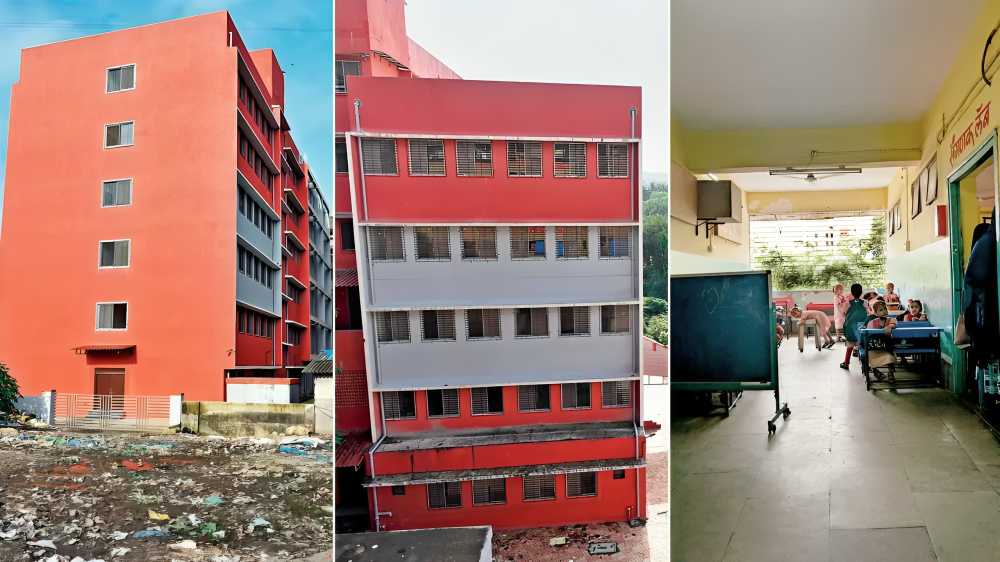

August 8, 2025: A state-of-the-art CBSE public school in Mumbai’s Govandi has stood unused for nearly a year after its completion—not because of construction delays, but due to a missing access road. Over 600 students continue to study in borrowed, overcrowded classrooms while the purpose-built school building remains locked, surrounded by piles of rubbish.
Commissioned by the Mumbai Metropolitan Region Development Authority (MMRDA) and managed by the Brihanmumbai Municipal Corporation (BMC), the Mumbai Public School CBSE near Natwar Parekh Compound was hailed as a flagship project for the underprivileged M East Ward. However, a glaring planning lapse—failure to build a proper approach road—has left the facility in limbo.
Civic officials state that for any school to be operational, fire and emergency services require a minimum 9-metre-wide access road. Currently, the main gate is blocked by waste and a pothole-ridden dirt track. The secondary gate, which adjoins a residential complex, remains closed. Officials from the BMC’s M East Ward confirm that without a motorable road, the building cannot be certified for student use.
Despite the completed structure housing 30 modern classrooms, students are still attending lessons at the Shivajinagar BMC School Group I, where they share seven rooms with an existing Urdu-medium school. Teachers have been conducting classes in corridors and makeshift areas. Remarkably, the school has achieved a 100% pass rate and boasts student achievements including Olympiad medals and young published authors.
Parents, who had enrolled their children in the new CBSE school with hopes of better public education, have expressed growing frustration. The Parent-Teacher Association has submitted repeated appeals demanding urgent action, warning that continued delays could endanger both learning quality and student safety.
Experts highlight this as symptomatic of larger infrastructural neglect in marginalised areas. Govandi remains one of Mumbai’s most underserved regions, and residents worry the situation reflects deeper institutional apathy. Civic planners are now under pressure to turn a promising project into a functioning one—and deliver not just a school building, but a safe, accessible centre for learning.
Source: Urban Acres