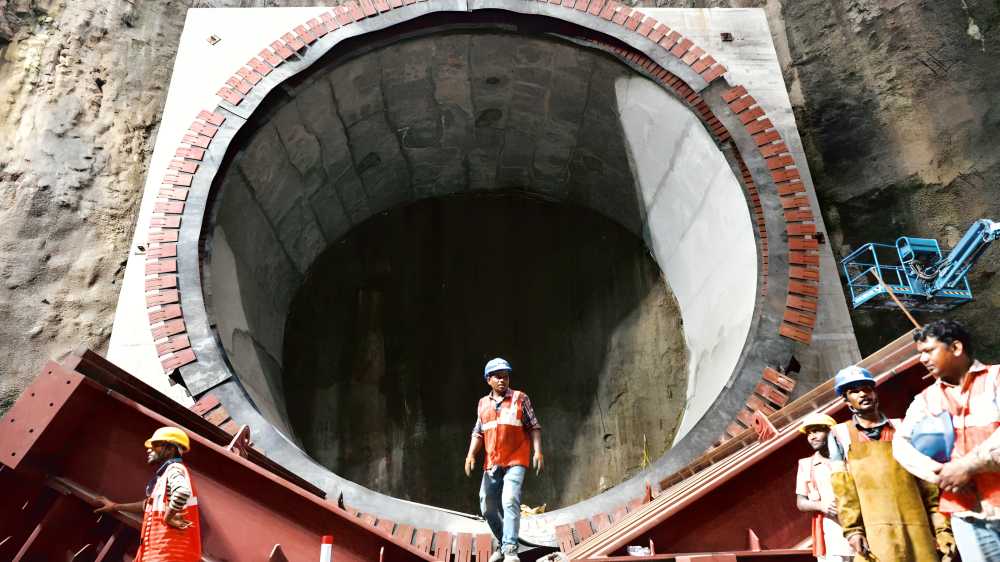

Towering viaducts above urban skylines, massive steel bridges, an undersea tunnel and advanced Japanese technology are steadily transforming India’s ambitious Mumbai–Ahmedabad Bullet Train corridor into reality. Stretching 508 km between Mumbai and Ahmedabad, the high-speed rail project is among the country’s largest and most complex infrastructure undertakings.
At an under-construction viaduct site in Vaktana village near Surat, engineers are working nearly 23 metres above ground level to build infrastructure capable of supporting trains travelling at speeds of up to 320 kmph. The corridor includes 53 steel and river bridges, elevated sections crossing dense urban regions and a 7-km undersea tunnel near Mumbai, highlighting the massive engineering scale of the project.
At the site, engineers are focused on one of the most critical components of high-speed rail construction — track stability and vibration control. A specialised Japanese machine known as the Cement Asphalt Mortar (CAM) injection car is being deployed in India for the first time to create a cushioning layer between the track slab and rail system.
The machine lays a 40-100 mm layer of mortar beneath the tracks, designed to absorb vibrations generated by trains travelling at extremely high speeds. According to engineers working at the site, the material used contains a “secret ingredient” developed using Japanese high-speed rail expertise.
Site inspector Anantha Guru, while overseeing work on the viaduct, explained that the technology is essential for maintaining ride comfort, track precision and operational safety at speeds exceeding 300 kmph.
The Mumbai–Ahmedabad High Speed Rail corridor is being developed with Japanese collaboration and technology under the Shinkansen model. Once operational, the project is expected to drastically reduce travel time between the two cities while introducing India to next-generation rail transportation standards.
Construction activity is currently underway across multiple sections of Gujarat and Maharashtra, with large-scale bridge work, viaduct construction and station development progressing simultaneously along the route.
Source: The Indian Express