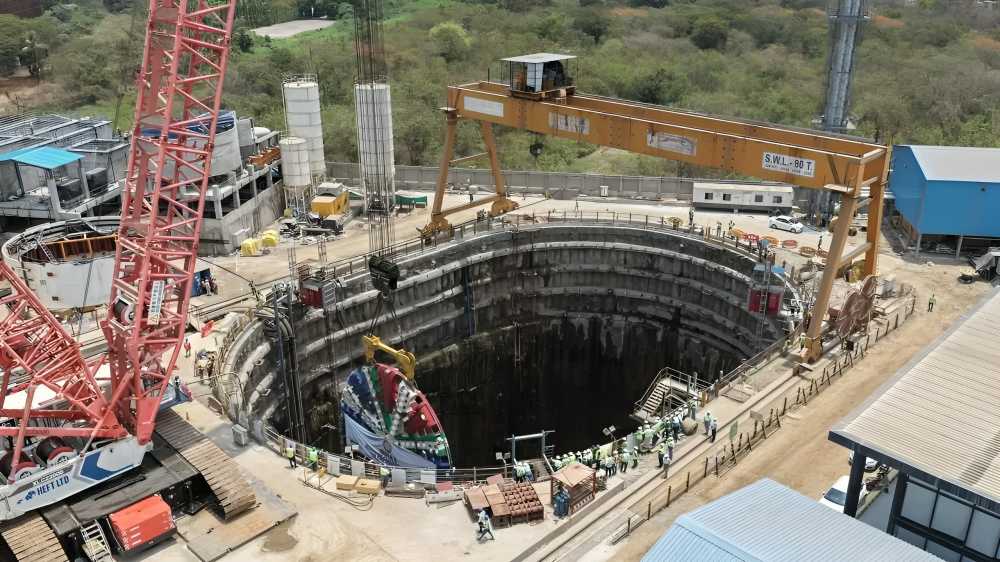

Construction of India’s first undersea rail tunnel for the Mumbai-Ahmedabad Bullet Train project has reached another milestone, with the second tunnel boring machine (TBM) commencing excavation beneath Thane Creek.
According to the National High Speed Rail Corporation Limited (NHSRCL), the second TBM started its drive on Saturday from Sawli in Ghansoli towards Vikhroli. The machine will excavate part of the 10-km underground stretch, including a 7-km section passing beneath the seabed of Thane Creek, making it the country’s first undersea rail tunnel.
The undersea section forms part of the 21-km underground corridor between Bandra-Kurla Complex (BKC) and Sawli. Of this, 16 km is being excavated using tunnel boring machines, while the remaining 5 km has already been completed using the New Austrian Tunnelling Method (NATM). Earlier this month, the first TBM began its 6-km drive from Vikhroli towards BKC.
The NHSRCL said the TBM is among the largest machines deployed for railway tunnel construction in India. It features a cutterhead measuring 13.6 metres in diameter, stands 96 metres long and weighs nearly 3,200 tonnes. The machine uses a pressurised bentonite slurry system to stabilise the tunnel face while minimising ground disturbance during excavation beneath densely populated areas of the Mumbai Metropolitan Region.
The project also incorporates multiple safety systems, including real-time monitoring of methane, oxygen, carbon monoxide and carbon dioxide levels, along with water sprinkler networks on designated escape routes. Surface infrastructure includes water and slurry treatment plants, bentonite storage facilities, backup power systems and a concrete grouting plant. Engineers are also using settlement sensors, strain gauges, optical displacement sensors and seismographs to continuously monitor ground movement and protect nearby structures.
The 508-km Mumbai-Ahmedabad High-Speed Rail corridor is being developed at an estimated cost of Rs 1.08 lakh crore, with financial support from the Government of India, the governments of Maharashtra and Gujarat, and a long-term loan from Japan carrying an interest rate of 0.1%.
Source: Mid-day