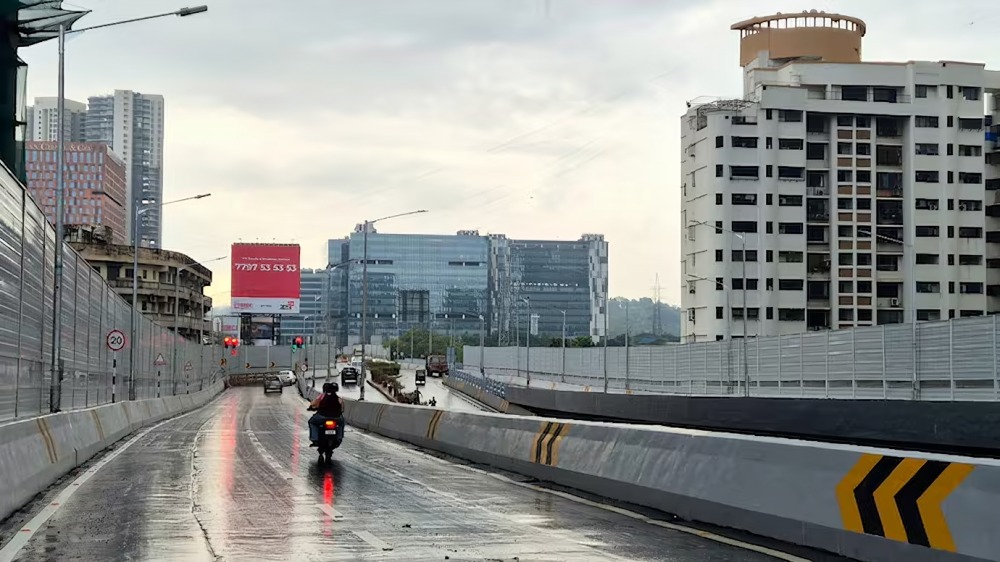

Mumbai’s Rs 248-crore Mrinaltai Gore Flyover has come under scrutiny after two-wheeler riders reported skidding on its unusually smooth road surface, particularly during wet conditions. The concern is most pronounced on the arm leading towards Relief Road, where adequate tyre grip is critical while negotiating bends.
Inaugurated on June 6, 2026, the flyover has faced criticism since its opening, including reports of potholes and damaged sections. The latest concerns centre on the surface quality and its grip for two-wheelers.
Transport planner Vivek Pai said road conditions in Mumbai can vary depending on traffic, rainfall, construction materials and surface treatment. He said the newly constructed Mrinaltai Gore Flyover should not necessarily be compared with older roads, where years of traffic can alter the road surface.
“Every kind of road is different. When you talk about Bandra-Kurla Complex, it is a different kind of road. When you talk about Mrinaltai Gore Flyover, it’s a different kind of road. Each one has its own kind of issues,” Pai told India Today Digital.
The flyover has a 40-mm-thick mastic asphalt surface, a material used to create a durable and relatively smooth road surface. According to the Brihanmumbai Municipal Corporation (BMC), stone chippings are spread over the mastic asphalt to improve friction and provide skid resistance.
However, motorists have reported that parts of the flyover feel excessively slick. The concern is particularly significant for two-wheelers, which are more vulnerable to loss of traction while braking or turning.
“The mastic surface was getting very, very slick. And in addition, you also had this kind of patchiness,” Pai said.
Bitumen Bleeding Could Reduce Road Grip
One possible reason for excessive smoothness on asphalt roads is bitumen bleeding. Bitumen acts as a binder for the aggregate, but under certain conditions, excess bitumen can rise to the surface and form a glossy layer over the road stones. This can reduce the surface texture available for tyre grip.
“Generally, wherever you have this kind of stickiness, it is because of the asphalt being used,” Pai said. “In technical terms, we call it bleeding of bitumen because of traffic. The bitumen goes to the surface and forms a glossy coat on top, because of which it becomes really smooth,” he added.
This is different from aggregate polishing, which occurs when repeated traffic gradually wears down the rough texture of stones used in the road surface. Both conditions can reduce surface texture and affect tyre-road friction.
The flyover has also reportedly seen loose stones, uneven patches and other surface irregularities, adding to concerns among two-wheeler users, particularly during rainfall.
Pai noted that Mumbai uses a range of road-building materials and construction methods, with contractors continuing to experiment with different techniques and materials.
“Contractors keep experimenting with new materials. Sometimes to save money, sometimes something new has come and they think, let’s try this, let’s try that,” he said.
With the flyover still relatively new, the reported skidding incidents have raised questions about the performance of its road surface, construction quality and whether adequate skid resistance is being maintained, particularly on bends and during wet weather.
Source: India Today