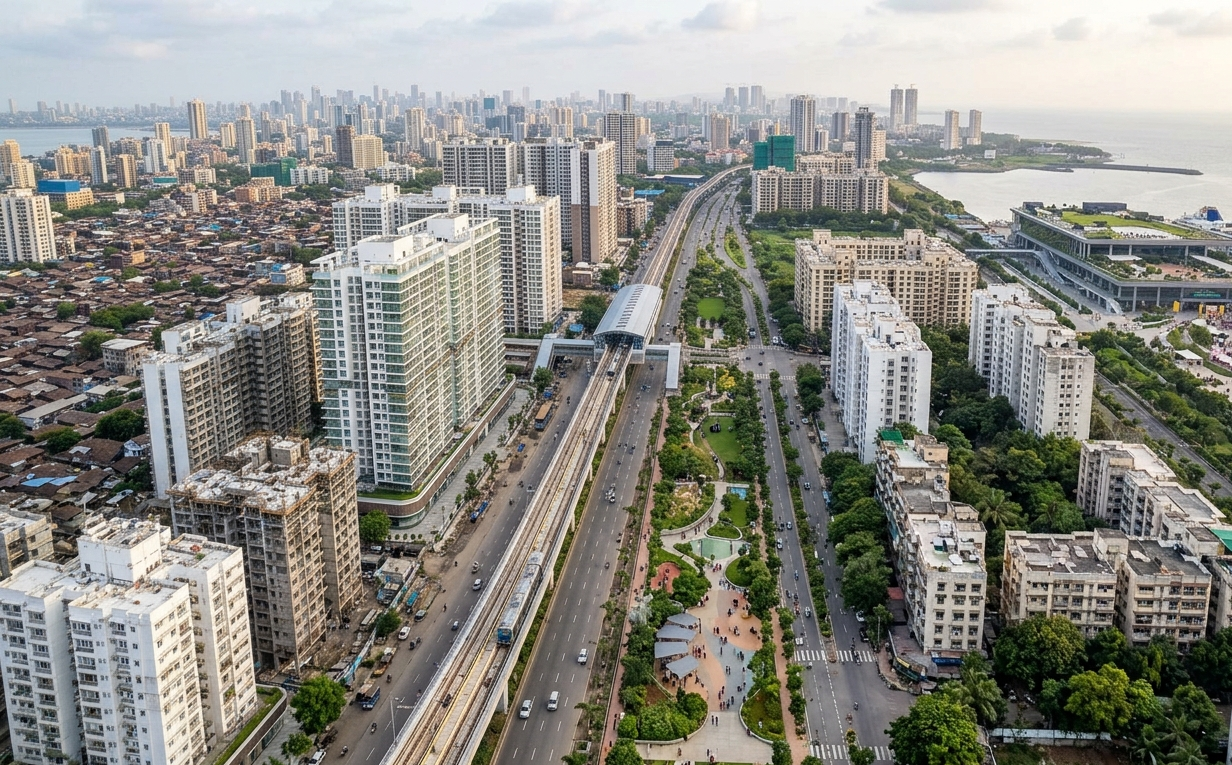

Mumbai’s limited availability of large developable land parcels is drawing major corporate groups towards slum and cluster redevelopment, with recent changes in the Slum Rehabilitation Authority (SRA) framework making larger projects more accessible.
The new policy envisages more than five lakh rehabilitation homes and 19 cluster development locations by 2030. It permits eligible large clusters to be planned collectively, reduces dependence on individual resident consent and allows mixed-use development across larger parcels.
Reliance Industries entered the segment in June after its real estate arm, Reliance 4IR Realty Development, won the bid for the 101-acre Juhu Lane-Gilbert Hill slum cluster. JSW Realty was also among interested bidders, while Mahindra & Mahindra has indicated that it may examine opportunities in the sector. Adani Group is already involved through the Dharavi redevelopment project.
“This redevelopment proposal under the new rule is less risky, it allows for hassle-free handover of the plot, it is no longer the builder’s prerogative to procure tenant consent and the ratio of the land size to FSI is also attractive,” said Pankaj Kapoor, founder and managing director of real estate research firm Liases Foras.
Industry observers say the attraction lies in access to large, contiguous land parcels and potentially stronger project economics. “There are two major opportunities — the first is in rehabilitating and providing housing to eligible and impacted residents. The second is the access it provides to precious land which, under any other circumstances, would never hit the market at all,” said Anuj Puri, chairman of ANAROCK Group.
Adani is pursuing Dharavi along with MHADA redevelopment projects, while Mahindra & Mahindra is assessing the segment.
“Slum redevelopment is something we have not prioritised as of now. But given the way the market is shaping, we’ll start looking at some of those deals,” M&M executives said on a recent analyst call.
The sector offers long development timelines, with projects potentially spanning 15-20 years, compared with shorter conventional redevelopment cycles.
However, financial strength alone may not guarantee success. Puri said, “Technically, anyone can try their hand, but practically, this is not a very friendly market for new players. They need to have deep local connections, understand exactly how this system works, be able to garner the trust of the affected residents, and have superlative execution capacity. All these often count for more than just the balance sheet.”
With 1,202 active SRA projects covering 2,156 acres, according to a JLL report cited in the source, competition for large redevelopment opportunities could intensify as Mumbai expands its rehabilitation pipeline.
Source: The Core