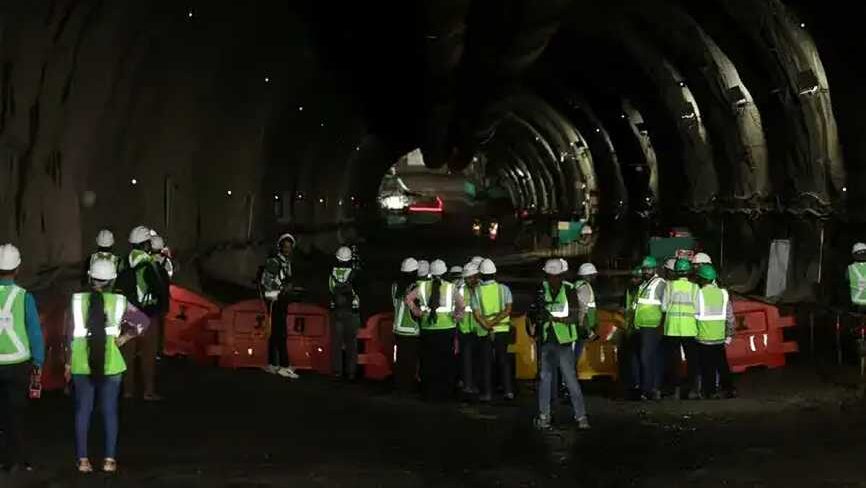

The Maharashtra government has reviewed a proposed 31-km integrated road tunnel network, named ‘Patal Lok’, aimed at improving connectivity across Mumbai and reducing traffic congestion on major roads. The project is designed to connect important commercial centres, transport hubs and express highways through an underground network of entry and exit routes.
The proposal was presented by the Mumbai Metropolitan Region Development Authority (MMRDA) to Chief Minister Devendra Fadnavis during a meeting at his official residence, Varsha, on Thursday.
The planned tunnel network will connect the Bandra-Worli Sea Link, the proposed bullet train station at Bandra-Kurla Complex (BKC), Dharavi, Terminal 2 of Chhatrapati Shivaji Maharaj International Airport, and the Western and Eastern Express Highways.
With an estimated length of approximately 31 km in one direction, the project is expected to establish a direct east-west transport corridor across the city. It is also intended to improve access to major business districts, particularly BKC, and the international airport while reducing pressure on existing road networks.
The proposed underground infrastructure is part of broader efforts to strengthen Mumbai’s transport system and improve movement between the eastern and western parts of the metropolitan region.
Revised Alignment For Uttan-Virar Corridor
During the same meeting, the MMRDA also presented two alternative alignments for the proposed Bhayandar/Uttan-Virar corridor, which is planned to strengthen connectivity towards the upcoming Vadhavan Port.
The sea bridge connecting Bhayandar/Uttan with Virar had received approval earlier. However, officials discussed alternative routes as part of a review of the project’s alignment.
Both infrastructure proposals are expected to complement the planned ring road network across the Mumbai Metropolitan Region (MMR). Once implemented, the projects could improve regional connectivity, offer additional travel routes and reduce commuting time across key locations in and around Mumbai.
Source: Economic Times