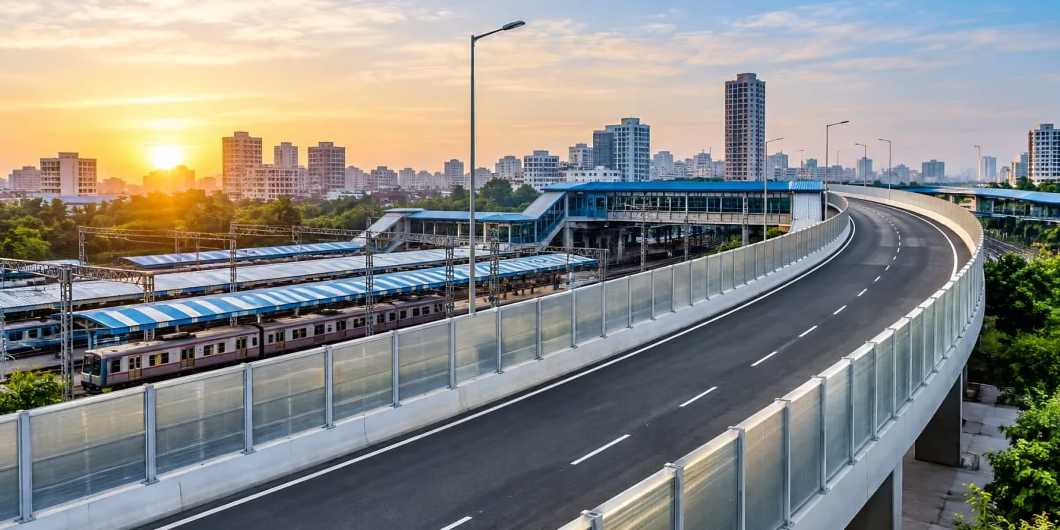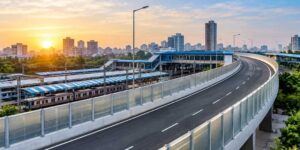

December 22, 2025: The Mumbai Metropolitan Region Development Authority (MMRDA) has commenced construction of the 13.9-km Elevated Eastern Freeway Extension, a major infrastructure project intended to dramatically reduce travel time between South Mumbai and Thane. The fully elevated, six-lane high-speed corridor will run from Anand Nagar in Thane to Chheda Nagar in Ghatkopar, offering a faster alternative to the heavily congested Eastern Express Highway.
Work on the project is already underway, with preliminary surveys, test piling and most geotechnical studies completed. Piling and pier construction are currently in progress, following the award of the construction contract in late 2024. As per official timelines, the project carries a 36-month construction schedule after receiving design and environmental approvals, placing its likely completion around late 2028 or early 2029.
The elevated corridor will improve east–west and north–south connectivity across the Mumbai Metropolitan Region. Key interchanges and access points are planned at Mulund, Airoli, JVLR, Vikhroli, Kanjurmarg, Mankhurd and Ghatkopar. At the Thane end, the freeway will integrate with the Anand Nagar–Saket Elevated Road near the former Mulund Octroi Naka, creating a seamless high-speed link with onward access to the Samruddhi Expressway.
A notable aspect of the project is its innovative engineering. The freeway will use a single-pile, single-pier structural system—being implemented for the first time in the region—with 2.5-metre diameter monopiles, 40-metre spans and a 25-metre single-segment superstructure. Supporting infrastructure includes entry and exit ramps at Mulund Check Naka, Airoli and Vikhroli, along with a 3+3 lane elevated toll plaza near the Navghar Flyover.
Environmental considerations have also shaped the project. The alignment between Vikhroli and Ghatkopar has been adjusted to preserve 127 Pink Trumpet trees, while 4,175 trees will be planted as compensatory green cover.
Once operational, the Elevated Eastern Freeway Extension is expected to ease congestion, cut emissions, and provide a quicker, safer commute, while also supporting economic growth across the region.