
Maharashtra’s decision to abolish the non-agricultural tax is more than a revenue adjustment. It is a governance reform aimed at easing one of the procedural layers that has long complicated land development in the state. At a time when the housing market is active but structurally constrained, simplifying land conversion rules is a practical and forward-looking step.
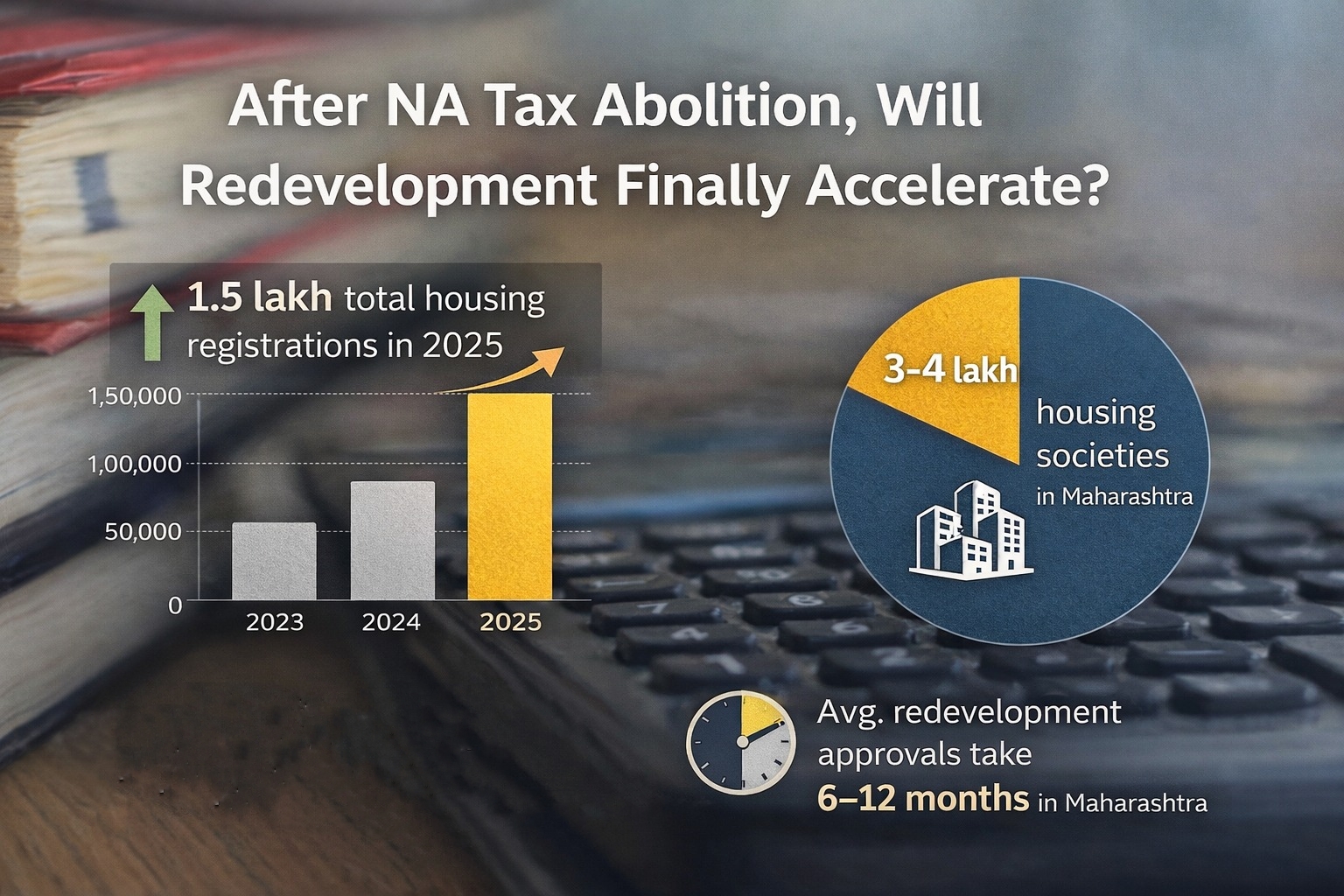
The numbers underline the market’s strength. In 2025, the Mumbai region recorded over 1.5 lakh property registrations, the highest in 14 years, generating more than Rs 13,400 crore in stamp duty collections according to industry data. Demand has held up despite affordability concerns and broader economic pressures. Maharashtra also continues to rely heavily on real estate revenues, with stamp duty collections crossing Rs 45,000 crore in FY24. Real estate remains central to both household investment and state finances.
Yet the pace of supply creation tells a more layered story. Maharashtra has an estimated 3 to 4 lakh housing societies, many of them aging and eligible for redevelopment. In practice, projects often face long approval cycles. Nonagricultural conversion, plan sanctioning, and related permissions have in many cases taken six to twelve months or more. Each additional clearance increases uncertainty and pushes up holding costs.
The amendment to the Maharashtra Land Revenue Code addresses one specific but important step in this chain. The earlier system imposed an annual NA tax on land converted from agricultural to non-agricultural use, typically ranging between 0.1% and 0.5% depending on classification. The revised framework replaces this recurring levy with a one-time conversion premium payable at the time of development permission or building plan approval. The premium is structured in slabs: 0.10% of market value for plots up to 1,000 square metres, 0.25% for 1,001 to 4,000 square metres, and 0.50% for larger parcels. Once paid, the land status is updated digitally and no separate sanad is required for transactions or loans.
This shift is significant for reasons of clarity and compliance. The non-agricultural tax was not the largest element of project cost. In Mumbai, land itself accounts for 40 to 60 percent of total development cost, and government levies remain substantial. The reform does not dramatically lower the overall cost burden. Instead, it changes the structure of payment. By moving from a recurring annual levy to a one time premium embedded within the approval process, the state reduces the risk of accumulated dues and simplifies documentation.
That said, it would be unrealistic to expect this measure alone to transform affordability. Market trends in 2025 call for a balanced view. In the first quarter of the year, unsold inventory of luxury homes priced above Rs 2.5 crore in Mumbai rose 36 percent year on year to around 8,420 units. Across segments, housing launches have softened in certain categories nationally, while prime rentals have increased by up to 25 percent in some locations. These shifts reflect changing demand patterns and supply constraints that extend beyond administrative procedures.
Housing prices are shaped by land values, infrastructure capacity, financing conditions, and construction costs. Streamlining non agricultural conversion can shorten timelines and improve predictability, but it does not alter the underlying economics of urban land. The gap between high land costs and middle income purchasing power remains a structural issue.
Where the reform can have a meaningful effect is in redevelopment. With lakhs of cooperative housing societies awaiting renewal, even modest reductions in approval time can help unlock projects that have been stalled by layered compliance requirements. Integrating conversion into the building approval workflow and digitising land status updates can improve transparency and reduce duplication.
The broader policy direction is constructive. Maharashtra has chosen to simplify a legacy process and align it with modern digital governance practices. The benefits will depend on consistent implementation and coordination with other approvals that influence project timelines.
In essence, abolishing the non-agricultural tax will not by itself lower home prices. It was not designed to. Its value lies in reducing procedural friction and improving certainty in land transactions. In a sector where time and clarity directly affect cost and confidence, that is a step in the right direction.