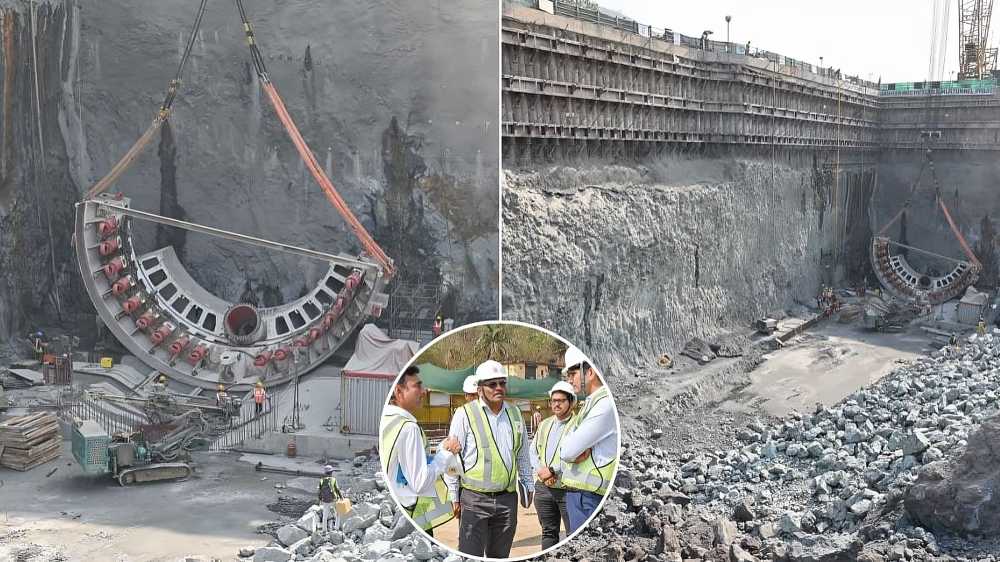

Work on the twin tunnels of the Goregaon–Mulund Link Road (GMLR) has gathered momentum, with the assembly of Tunnel Boring Machines (TBMs) currently underway at the launch shaft. The Brihanmumbai Municipal Corporation is closely monitoring the process, given the technical complexity involved in initiating tunnelling operations.
Dismantled TBM components are being lowered into the shaft, marking a critical phase of the project. Officials have been instructed to put contingency measures in place, including backup systems and sufficient manpower, to ensure smooth execution and avoid delays.
Abhijit Bangar, Additional Municipal Commissioner (Projects), inspected the site along with engineers from the Bridge Department and reviewed the progress. The launch shaft measures approximately 200 metres in length, 50 metres in width, and 30 metres in depth, with excavation work now fully completed.
At the base of the shaft, a specially designed curved concrete cradle measuring 20 m × 20 m × 2.5 m has been constructed. According to officials, this structure plays a crucial role in stabilising the TBM and ensuring precise alignment during the initial stages of tunnelling.
The 12.2-km GMLR project is expected to significantly enhance east-west connectivity across Mumbai. It will link Dadasaheb Phalke Chitranagari in Goregaon to Khindipada in Mulund through twin underground tunnels, each stretching 4.7 km. The tunnels will pass beneath the Sanjay Gandhi National Park, navigating through its hilly terrain entirely underground.
Each tunnel will accommodate three lanes and will be equipped with modern ventilation systems, fire safety mechanisms, stormwater drainage, and utility ducts. Excavation will be carried out using two massive TBMs—each 14.49 metres in diameter and weighing around 2,175 metric tonnes—manufactured by Terratec.
Once completed, the project is expected to reduce travel time and ease congestion between the city’s western and eastern suburbs.
Source: The Free Press Journal