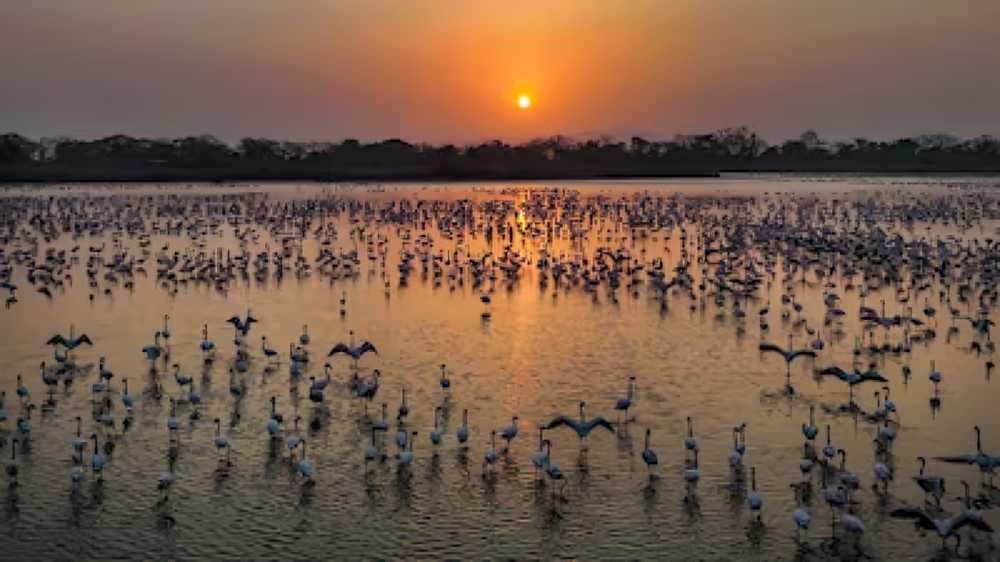

A major controversy has erupted in the Navi Mumbai region after the Thane district-level Wetland Committee ruled that key flamingo habitats, including NRI Flamingo Point and TS Chanakya lakes, do not qualify as wetlands under the Wetlands (Conservation and Management) Rules, 2017. The decision is part of a wider assessment of eight water bodies across Thane and Navi Mumbai.
The ruling has triggered sharp criticism from environmental groups, who argue that the committee has overlooked ecological data, judicial observations, and central government guidelines. Conservationists maintain that these sites are not isolated water bodies but form an essential part of the larger ecosystem connected to the Thane Creek Flamingo Sanctuary, a globally important habitat for migratory flamingos.
Calling the report “deeply flawed,” the NatConnect Foundation stated that both locations function as satellite wetlands supporting biodiversity and ecological balance. The group also cited earlier studies by the Wildlife Institute of India, which highlighted the importance of protecting Navi Mumbai’s wetland systems.
However, the committee reportedly based its decision largely on land-use classifications, citing artificial origins, zoning designations, and prior ownership patterns. In the case of Flamingo Point, its inclusion in development plans, including proposals for a golf course, was used as justification. TS Chanakya was similarly classified as institutional land.
Environmentalists have also raised concerns that the report does not reference earlier observations by the Bombay High Court in a related public interest litigation, which had treated nearby water bodies as ecologically sensitive. The matter is currently sub judice following a challenge by CIDCO in the Supreme Court.
Critics, including BN Kumar of NatConnect, questioned reliance on planning agencies for ecological classification, stating, “What is worrying is the reliance on CIDCO’s inputs to determine wetland status,” and adding that wetland identification is the responsibility of the State Wetlands Authority.
Further concerns were raised over limited use of scientific mapping data from the National Centre for Sustainable Coastal Management, which is responsible for wetland documentation under the national atlas programme.
Other water bodies, including Lotus Lake and the so-called Jewel of Navi Mumbai, were also excluded on similar grounds, being classified as modified or artificial stormwater systems.
Environmentalists argue that such exclusions contradict India’s commitments under the Ramsar Convention, which recognises both natural and artificial wetlands if they support ecological functions. They warn that redefining such habitats as “non-wetlands” could weaken long-term urban ecological protection.
Source: News18