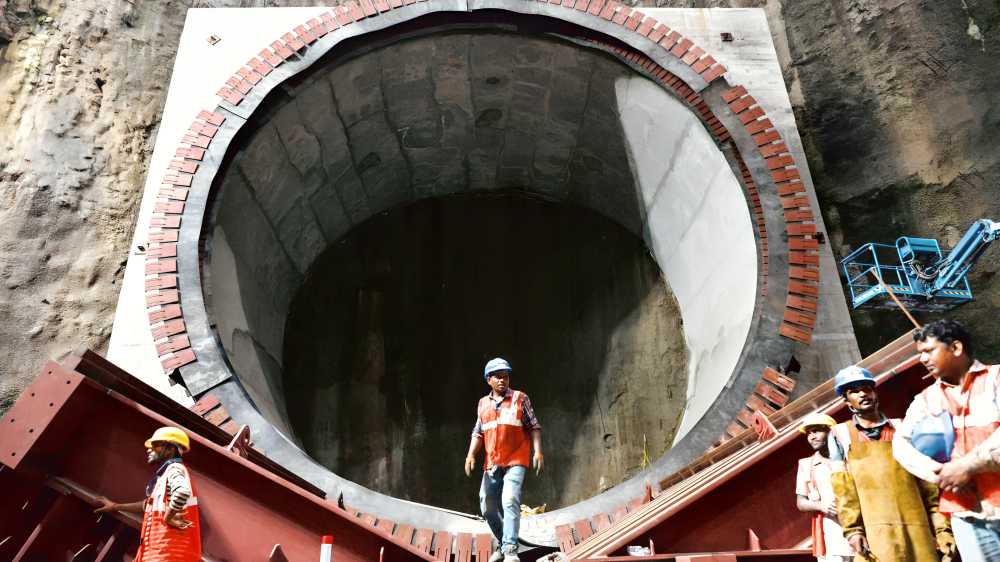

India’s first bullet train corridor between Mumbai and Ahmedabad is steadily moving from blueprint to reality, with large-scale construction now visible across the 508-km route. Designed for speeds of up to 320 kmph, the Mumbai-Ahmedabad High Speed Rail (MAHSR) project is among the country’s biggest infrastructure initiatives, involving elevated viaducts, steel bridges, mountain tunnels and India’s first undersea rail tunnel.
The Rs 1.98 lakh crore project, launched in 2017, is being developed with technical and financial assistance from Japan through the Japan International Cooperation Agency (JICA). The corridor is expected to become operational by 2029, while the first section between Surat and Bilimora is targeted for completion by August 2027.
A major portion of the route is being constructed on elevated viaducts to ensure safety and uninterrupted operations at high speeds. According to officials from the National High Speed Rail Corporation Limited (NHSRCL), more than 90 per cent of the corridor will run on elevated structures rising over 20 metres above ground level.
Near Surat, engineers are currently working with specialised Japanese machinery used to install Cement Asphalt Mortar (CAM), a cushioning layer placed between the track slab and rail system to absorb vibrations generated at high speeds. Officials said the technology is being used in India for the first time.
At Kim in Surat district, track slabs weighing around 4.5 tonnes each are being manufactured for the Vapi-Vadodara section. The facility can produce up to 120 slabs per day, with more than 36,000 slabs already completed.
The project also includes 28 steel bridges and 53 river bridges across the corridor. Near Ahmedabad’s Sabarmati riverfront, engineers are constructing viaduct foundations deep below the riverbed to support the elevated network.
As the corridor enters Maharashtra through Palghar district, construction shifts from viaducts to tunnels cutting through the foothills of the Sahyadris. Around 26 km of the route will run underground, including a 7-km undersea tunnel beneath Thane Creek — the first such rail tunnel in India.
At Basantwadi near Dahanu, engineers are using advanced monitoring systems during excavation due to the region’s unstable basalt rock formations. Officials said specialised systems have been deployed to detect any risk of tunnel collapse in real time.
At Shilphata near Mumbai, tunnelling work is progressing beneath critical infrastructure including water and gas pipelines. Engineers stated that some excavation work had to be carried out manually to avoid damaging underground utilities.
The corridor will terminate at the underground station at Bandra-Kurla Complex in Mumbai, linking India’s financial capital with Ahmedabad through the country’s first high-speed rail network.
Source: The Indian Express