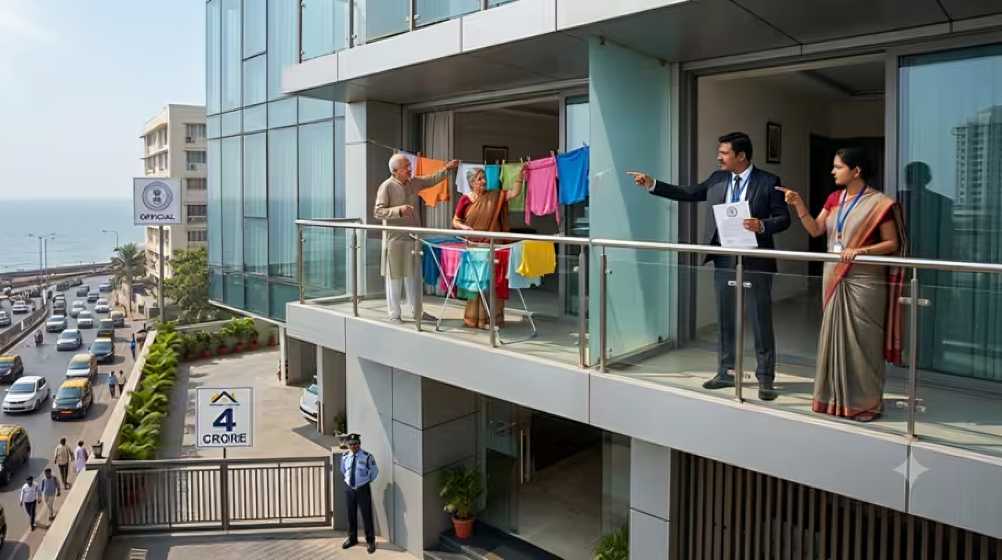

Buying a luxury apartment in Mumbai does not always mean complete freedom over every corner of the home. In several premium residential projects across areas such as Worli, Bandra, Powai and Lower Parel, residents are often restricted from drying clothes, towels or other items on balconies or outside windows, despite paying crores for their homes.
These restrictions are primarily introduced to maintain the building’s appearance, preserve the façade, and protect the premium image and property value of the development. However, they have also raised questions about whether housing societies can control how residents use their private balconies.
While there is no general municipal law in Mumbai that prohibits drying clothes on balconies, many cooperative housing societies and gated communities include such conditions in their registered bye-laws or internal rules. Legal experts say the issue involves balancing individual ownership rights with the collective interests of residents.
Under the Maharashtra Apartment Ownership Rules, 1972, Rule 44 prohibits condominium owners from hanging garments, rugs or similar items from windows, balconies or the external façade of buildings. However, this provision does not automatically apply to every housing society in Maharashtra.
Experts explain that condominiums are governed by the Maharashtra Apartment Ownership Act, 1970, while cooperative housing societies operate under the Maharashtra Cooperative Societies Act, 1960, the Maharashtra Cooperative Societies Rules, 1961, and their registered bye-laws.
Housing societies generally impose such restrictions to maintain uniformity, prevent water dripping onto lower floors, avoid safety hazards caused by falling objects and ensure that common areas and building exteriors remain well-maintained. Residents are usually encouraged to use utility balconies, designated drying spaces, indoor drying stands, ceiling-mounted racks or clothes dryers.
“Housing societies are free to frame rules for the smooth functioning of the community. However, unless a penalty is backed by law or the society’s registered bye-laws, enforcing fines can become contentious,” said Nishikant Patil, a real estate consultant based in Mumbai’s western suburbs.
“In luxury projects where apartments cost Rs 5 crore or Rs 10 crore and above, this issue rarely arises because most homes have a separate utility or dry balcony designed specifically for drying clothes. The challenge is more common in smaller apartments priced around Rs 1 crore or Rs 2 crore, where homes measuring 500–600 sq ft have limited space and often lack a dedicated drying area,” he said.
Similar restrictions exist in some international residential communities as well. Krushang Patel (name changed), a 38-year-old resident of a Singapore condominium, said his complex imposes a 100 Singapore dollar penalty if residents hang clothes or towels from visible windows or balcony railings.
“Our condominium has residents from across the world, and there have been instances where people hang towels outside after taking a bath. Some residents argue that while drying clothes may not be permitted, towels should be allowed. However, whenever someone violates the rule, the estate management issues a notice to the landlord, informing them of the breach,” Patel said.
As luxury housing communities continue to expand in Mumbai, the debate over balcony usage highlights the growing tension between personal choices and maintaining shared living standards.
Source: Hindustan Times