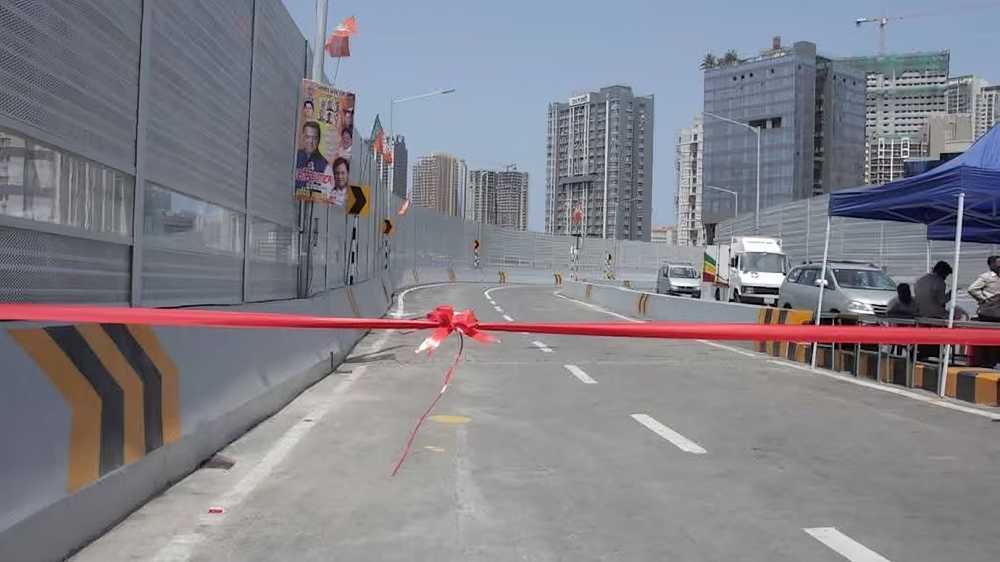

The newly opened extension of Mumbai’s Mrinaltai Gore Flyover has come under public scrutiny just days after its inauguration, with concerns emerging over the condition of the road surface and the overall quality of execution of the long-delayed infrastructure project.
The 750-metre flyover extension, inaugurated on June 6, was developed at a cost of Rs 248 crore and is intended to improve east-west connectivity between Ram Mandir Road, SV Road, Link Road and the Western Express Highway corridor. Originally sanctioned in 2018 with an expected completion timeline of two years, the project eventually took nearly eight years to complete, with costs rising substantially during the construction period.
Within days of opening to traffic, commuters and local observers began highlighting visible surface irregularities, uneven stretches and construction joints on the flyover. Several images and videos circulating online triggered criticism from opposition leaders, activists and residents, raising questions about construction quality despite the project’s recent completion.
Congress MP Varsha Gaikwad criticised the civic administration, stating, “The official handle of @mybmc has posted an aerial shot of the Mrinal Tai Gore flyover extension rather than an on-ground close up shot. But even from this height, the shoddy work, the uneven surface is quite visible. Shame!”
Social activist Zoru Bhathena also questioned the celebrations surrounding the project’s completion, saying, “What are they celebrating? That they were able to complete it after taking 8 years? Normal people would hang their head in shame. But. My BMC. They are celebrating their own incompetence.”
NCP-SP spokesperson Anish Gawande linked the controversy to the legacy of veteran socialist leader Mrinaltai Gore, after whom the flyover is named. “The flyover is named after the iconic Mrinal Tai Gore, who spent her whole life fighting so ordinary Mumbaikars got a life of dignity. After seven years, three cost revisions, and a daily penalty on the contractor — this is all they could come up with to honour her?” Gawande said.
“But kya karein. This is the standard now under the triple-engine sarkar. Cut the ribbon. Click the photo. Leave the potholes for us. Bajao taali,” he added.
The Brihanmumbai Municipal Corporation (BMC) has defended the project, maintaining that the visible joints and texture are part of the technical construction process. According to the civic body’s Bridges Department, the mastic asphalt surfacing used on the flyover can initially appear rough and uneven, particularly in sections requiring manual application, but is expected to settle and smoothen with regular vehicular movement.
The controversy has also revived discussions around an internal vigilance report from 2021 that reportedly flagged concerns regarding possible cracks and execution-related issues. Opposition leaders have since demanded independent quality assessments and third-party structural audits.
The episode has once again drawn attention to the broader debate around infrastructure delivery in Mumbai, where several high-profile projects have faced criticism over design, execution and maintenance despite significant public investment.
Source: India Today