
A 2,400-square-foot Mumbai apartment has been redesigned around an idea that is simple yet central to family life: creating spaces that allow people to remain connected. Architects Aayush Golecha and Kushaal Jhaveri of The Comma Collective transformed the original four-bedroom layout into a warmer and more flexible home for a young couple and their daughter.
Initially planned as a home office, the fourth bedroom took on a different purpose during the design process. The architects realised the couple’s daughter preferred staying close to her parents while they worked. The room was consequently converted into a Family Lounge, becoming the defining space of the home.
“Once we understood what the room actually meant to them, we wanted it to feel cosy, immersive, and experiential rather than functional,” says Golecha.
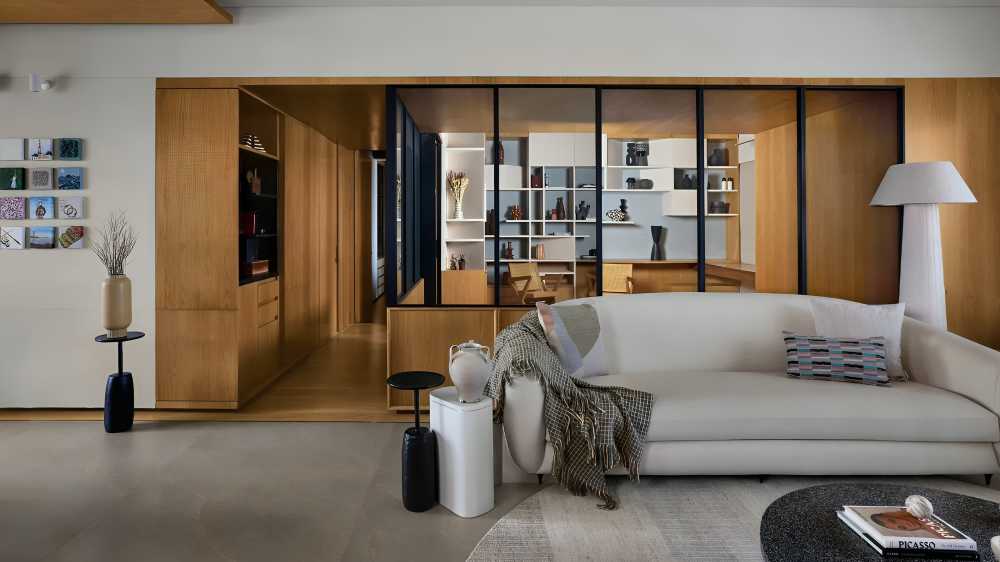
Wrapped in timber, the lounge features a 12-foot suspended desk and connects visually with the living room through switchable glass. It accommodates work as well as reading, play and family time.
The living and dining areas remain connected while retaining distinct identities. “The answer was to keep the framework consistent and let the details do the work of defining each zone,” explains Jhaveri.
The interiors combine timber, lime wash and textured stone with terrazzo, blue accents, patterned fabrics, wallpaper and hand-painted tiles.
“Keep the bones calm and grounded, and let the personality live in the smaller, closer details, so the house feels rich and layered without ever raising its voice,” says Golecha.
The bedrooms follow the same design language. The guest bedroom features a warm green palette and a window-side baithak, while the primary bedroom uses timber flooring and textured surfaces, with no television to preserve a quieter atmosphere.
The daughter’s room is designed for flexibility, with a custom bed, elevated play deck, hand-painted tiles and a writable glass panel.
“It’s a surface that’s meant to be used, not just looked at,” says Jhaveri.
“Our clients never wanted a show flat,” says Golecha. “They wanted something that felt unmistakably theirs, in every sense of the word.”
Source: Architectural Digest