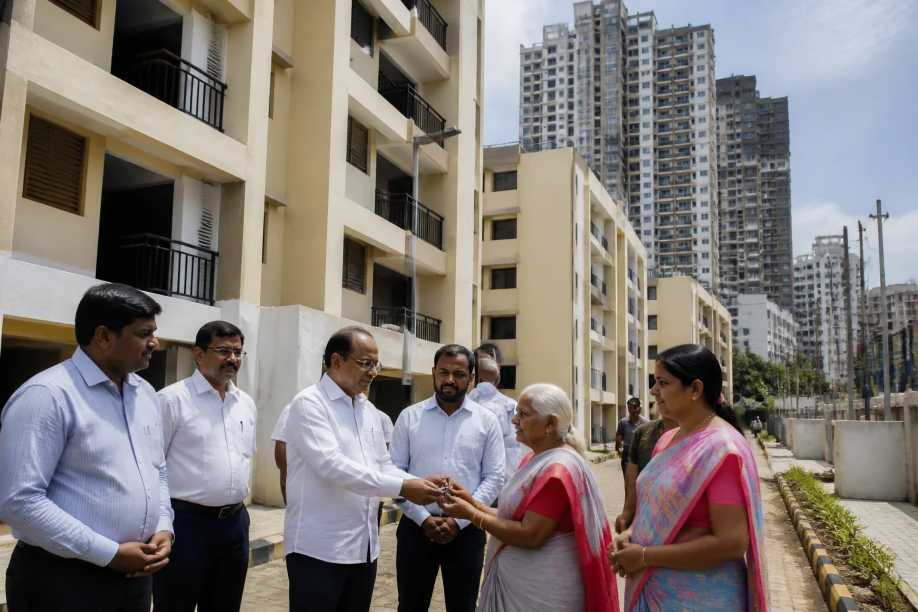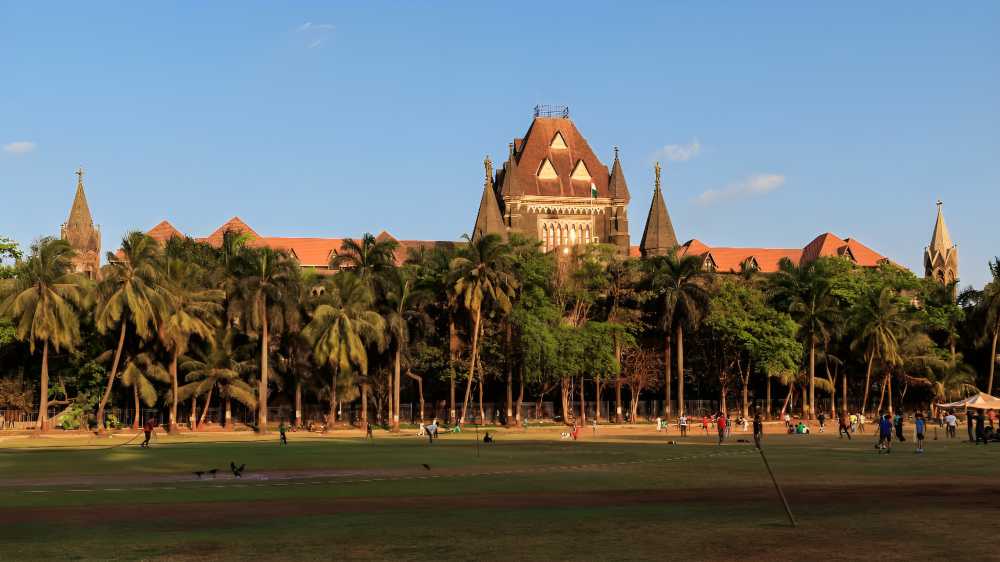

The Bombay High Court has called for greater involvement of state authorities and public land-owning agencies in slum rehabilitation projects on their land, observing that such an approach could prevent prolonged delays caused by disputes between slum dwellers’ groups and competing developers.
The court made the observations while hearing a petition filed by Ruparel Buildcon concerning its stalled redevelopment project at Siddharth Nagar in Chembur. Spread across nearly 66,000 sq m, the project was halted by the Slum Rehabilitation Authority (SRA) in February 2026.
A division bench comprising Justices Girish Kulkarni and Dr Neela Gokhale described Siddharth Nagar as “a classic case where the redevelopment of the slum has been delayed for almost 20 years”.
“..it is high time that the situation as brought about in the present proceedings, namely, of inter se conflicts between the societies of slum dwellers and the developer, becomes a relic of the past,” the bench said.
The judges directed the SRA chief executive officer to decide, within six weeks, on applications filed by residents challenging Ruparel Buildcon’s appointment as developer.
The court further said that if the developer’s appointment is cancelled by the CEO or another competent authority, Clause 1.15 of Regulation 33(10) of the Development Control and Promotion Regulations should be applied. Under this provision, the redevelopment scheme could be transferred to the state government, which owns the land, for implementation through an architect and developer selected under the applicable legal process.
The Siddharth Nagar project was first proposed in 2006 but remained stalled amid disputes involving cooperative societies representing residents and repeated litigation. In March 2021, the SRA approved Ruparel Buildcon as developer after a federation of 33 societies selected the company. Four months later, approval was granted for eight buildings containing 3,153 rehabilitation tenements, based on the consent of 823 of 1,520 eligible residents.
Some residents subsequently challenged the developer’s appointment, arguing that the federation had not secured their consent.
The court noted that while slum dwellers have a limited right to permanent alternate accommodation, they can approach the SRA under Section 13 of the Maharashtra Slums Act if redevelopment fails to progress within the prescribed period.
The bench also highlighted concerns over disputes and alleged “horse-trading” surrounding slum rehabilitation schemes. It said state agencies or public landowners could take charge to ensure timely implementation and explore alternative land-use options where appropriate.
The SRA CEO was directed to decide the residents’ applications within six weeks and provide adequate compensation to Ruparel Buildcon if its appointment is ultimately revoked.
Source: Hindustan Times