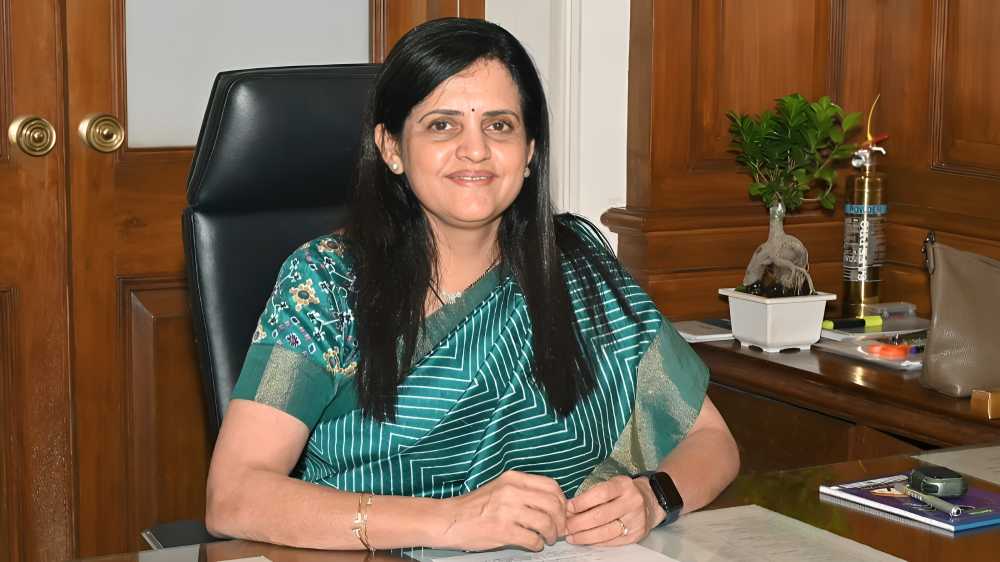

A month after assuming office as the first woman commissioner of the Brihanmumbai Municipal Corporation (BMC), Ashwini Bhide has outlined her priorities for Mumbai’s civic administration, stressing that basic services remain at the core of the corporation’s responsibilities despite the spotlight on mega infrastructure projects.
In a recent interaction with Nayonika Bose and Pratip Acharya, Bhide said that while large-scale infrastructure developments attract public attention, the BMC’s primary role continues to revolve around essential civic services such as roads, sanitation, water supply, healthcare, and education.
Highlighting the ongoing sewage treatment plant project, Bhide said it is among the city’s most significant initiatives as it combines infrastructure growth with civic necessity. According to her, the project is expected to treat nearly 2,200 MLD of sewage and enhance Mumbai’s water supply capacity by 1,100 MLD, improving the city’s overall liveability.
Speaking about the rare situation of three women occupying key positions in the civic administration, Bhide said, “When women are at the helm of the affairs, the perspective changes, and any change is better for the system because it breaks the norm, it breaks the myth, it breaks the monotony.”
She added that while she has always viewed herself as “an officer first,” women administrators may bring greater sensitivity towards issues of inclusivity, accessibility and household challenges faced by women, especially in densely populated settlements.
Addressing Mumbai’s recurring water concerns, Bhide said rainfall dependency cannot be eliminated entirely, but diversification through desalination projects, sewage water reuse and reduction of leakages in ageing pipelines will help improve efficiency.
On waste management, she acknowledged that garbage disposal remains a major challenge in slum areas. The BMC has identified nearly 140 garbage-vulnerable spots across Mumbai and has instructed ward-level teams to eliminate them through monitoring and public awareness initiatives.
Bhide also noted that the civic body generated nearly Rs 12,000 crore through development premium and FSI charges last year, while plans are underway to raise municipal bonds within the next six to seven months.
Source: The Indian Express