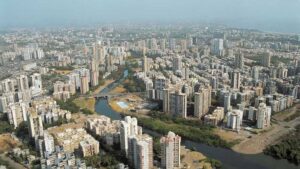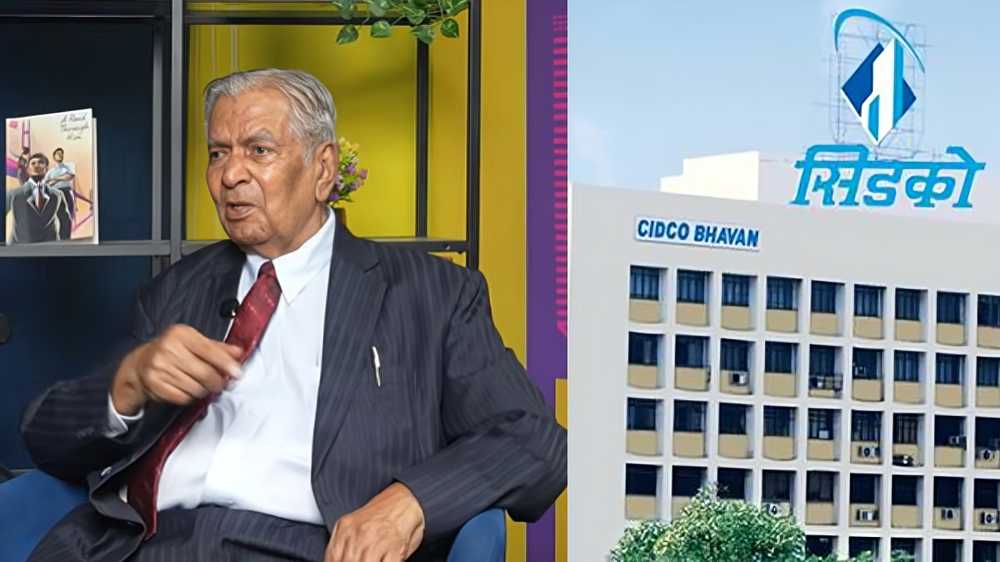

Former CIDCO Managing Director R. C. Sinha has reflected on the early years of Navi Mumbai’s development, stating that the satellite city, now home to lakhs of residents, once existed only as a vision without basic infrastructure such as roads, water supply or railway connectivity.
Speaking on the Indian Infra Show on PowerTrain by Aakash Bhavsar, Sinha said Navi Mumbai was first conceptualised in 1970 as a “counter magnet” to reduce pressure on Mumbai. However, according to him, meaningful development began only after 1990, when he joined CIDCO.
Recalling the condition of the city at the time, Sinha said, “There should be roads, railway lines, water and electricity, but there was nothing on the ground.”
He also claimed that CIDCO was facing severe financial difficulties during that period and struggled to even pay employee salaries.
According to Sinha, the first priority was to build the city’s basic infrastructure, including roads, electricity, water supply, schools, hospitals and communication systems. He recalled that electricity supply in New Bombay was irregular during the early years.
“New Bombay used to get electricity only for six days a week, and Thursday used to be an off day,” he said.
Sinha stated that CIDCO later coordinated with MSEB to improve the power network and worked on creating a dedicated water source through the Hetawane Dam near Panvel.
He also spoke about improving communication infrastructure, recalling how Navi Mumbai earlier required STD dialling to connect with Mumbai because it fell under a separate district. Questioning the arrangement, he had reportedly told officials, “You can give direct dial from one state to another state. Why can’t you give from one district to another district?”
Sinha described the Harbour Line railway as a major turning point in Navi Mumbai’s growth. Despite opposition to the project at the time, CIDCO proceeded with the railway expansion after discussions with the Railway Board.
“You are looking 25 years back, while we are looking 50 years ahead,” he said while recalling the resistance faced during planning.
He added, “The day the railway line came, land prices also increased in Navi Mumbai by 50 per cent.”
Sinha also described Navi Mumbai as a more planned city compared to Mumbai, highlighting its wider roads and drainage systems designed to reduce flooding and waterlogging.
At the same time, he questioned the need for the proposed “Mumbai 3.0” vision, arguing that future metropolitan development should expand beyond Maharashtra into regions such as Uttar Pradesh, Rajasthan and Madhya Pradesh.
Source: The Free Press Journal