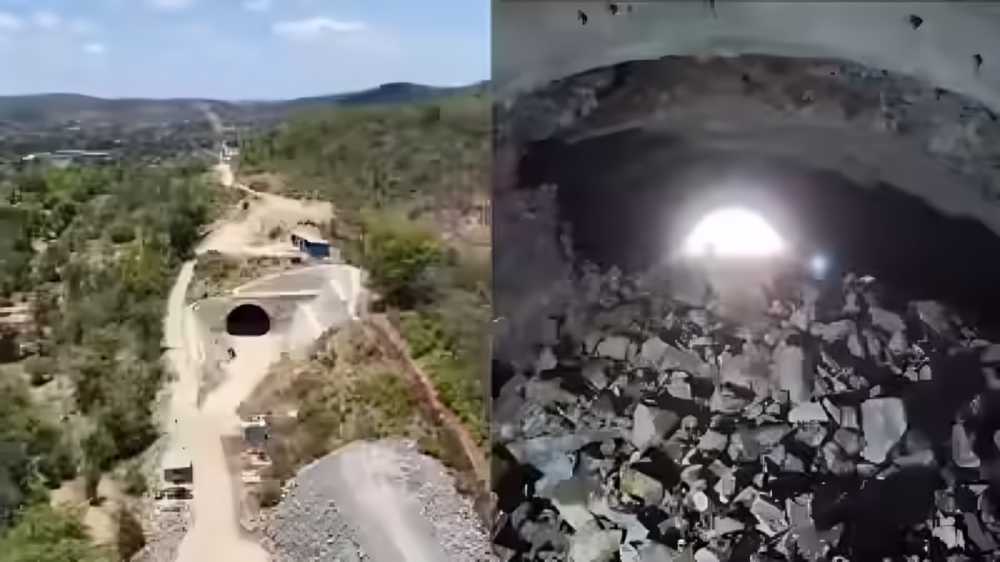

India’s first high-speed rail project reached another significant milestone as the Mumbai-Ahmedabad Bullet Train corridor recorded its third mountain tunnel breakthrough in Maharashtra within a span of five months. The latest achievement was completed in Dahanu taluka of Palghar district, highlighting the rapid pace of construction along the ambitious rail corridor.
Sharing the development on X, Union Railway Minister Ashwini Vaishnaw said, “Mumbai-Amdavad Bullet Train Project achieves another milestone…3rd mountain tunnel breakthrough in Maharashtra within 5 months. Dahanu Taluka, Palghar.”
The breakthrough comes as work accelerates across the 508-km Mumbai-Ahmedabad High-Speed Rail (MAHSR) route, nearly a decade after Prime Minister Narendra Modi and former Japanese Prime Minister Shinzo Abe jointly launched the project in Ahmedabad in 2017. Construction activities are progressing on multiple fronts, including elevated viaducts, station buildings and the undersea tunnel section near Mumbai. India’s first domestically developed high-speed trainset is also expected to be introduced by 2027.
Among the latest engineering achievements is the successful launch of a viaduct over the busy Kalupur flyover and a Railway Over Bridge on the Sabarmati–Mumbai section of Western Railway in Ahmedabad district. The structure, completed using the Span-by-Span method, involved installing a 45-metre-long span weighing approximately 1,200 metric tonnes. The bridge consists of 19 segments and connects seamlessly with the elevated corridor alignment.
The high-speed rail route will pass through Maharashtra, Gujarat, and the Union Territory of Dadra and Nagar Haveli and Daman and Diu, linking 12 stations, including Mumbai, Thane, Virar, Boisar, Surat, Vadodara, Ahmedabad and Sabarmati. Designed for speeds of up to 320 kmph, the corridor is expected to reduce travel time between Mumbai and Ahmedabad to just over two hours on limited-stop services.
Supported by Japanese Shinkansen technology and long-term concessional financing, the project is also envisioned as a major technology-transfer initiative under India’s Make in India programme.
Source: The Times of India