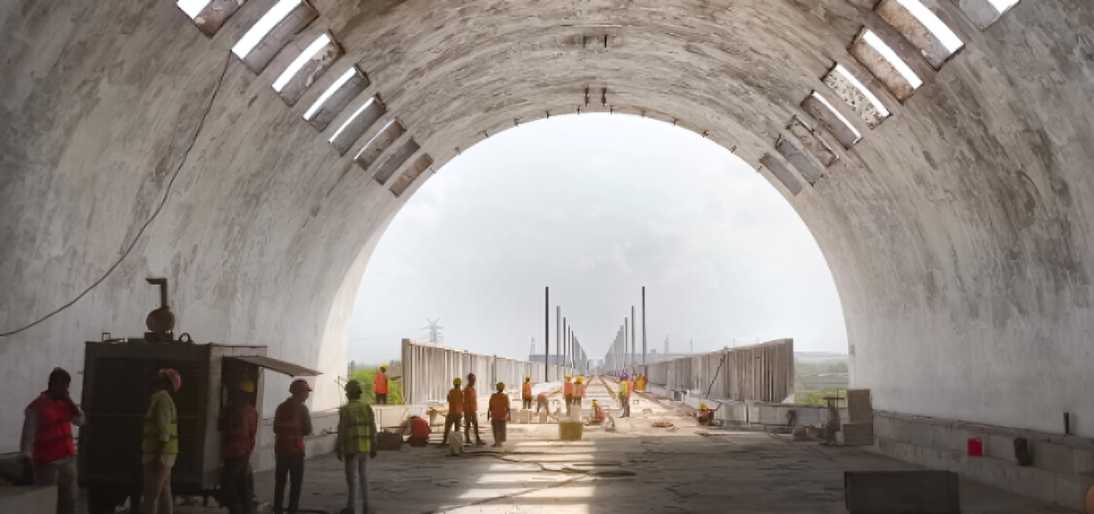

Construction of the Mumbai-Ahmedabad High-Speed Rail (MAHSR) corridor has entered a new phase with the introduction of tunnel hoods, a technology being deployed for the first time in India’s railway sector. The feature is being incorporated into the country’s first bullet train project as tunnel construction progresses across Maharashtra and Gujarat.
The 508-km high-speed rail corridor includes seven mountain tunnels in Maharashtra and one in Gujarat. Tunnel hoods will be installed at both the entry and exit points of each tunnel. Work on the entrance hood of the Gujarat tunnel in Valsad district has already advanced significantly and is nearing completion.
According to the National High Speed Rail Corporation Limited (NHSRCL), which is implementing the project, tunnel hoods have been specifically designed to address the tunnel boom effect generated by high-speed trains.
“This is the first time such tunnel hood technology has been designed and implemented for railway tunnels in India. It has been designed to mitigate the tunnel boom effect caused by pressure waves generated by high-speed trains,” said the National High Speed Rail Corporation Limited (NHSRCL), the project’s implementing agency.
Tunnel hoods are cylindrical structures fitted with pressure-relief vents or windows and are commonly used in countries operating bullet train networks where trains travel at speeds exceeding 300 kmph. They are positioned at tunnel entrances and exits to manage sudden changes in air pressure.
The need for these structures is particularly important along the Maharashtra section of the corridor, where the alignment passes through the challenging terrain of the Sahyadri mountain range in Palghar district. In these stretches, tunnels have been constructed instead of elevated viaducts, making engineering requirements more complex.
Explaining their function, a senior NHSRCL official said that when a high-speed train enters a tunnel, it acts like a piston, pushing a large volume of air ahead of it.
“This sudden compression of air generates pressure waves that travel through the tunnel. If not properly managed, these pressure waves can create booming noise, similar to the explosion, when a train exits the tunnel,” the official said.
The adoption of tunnel hood technology is expected to improve passenger comfort, reduce noise pollution and enhance the overall efficiency of the high-speed rail system.
Source: The Indian Express