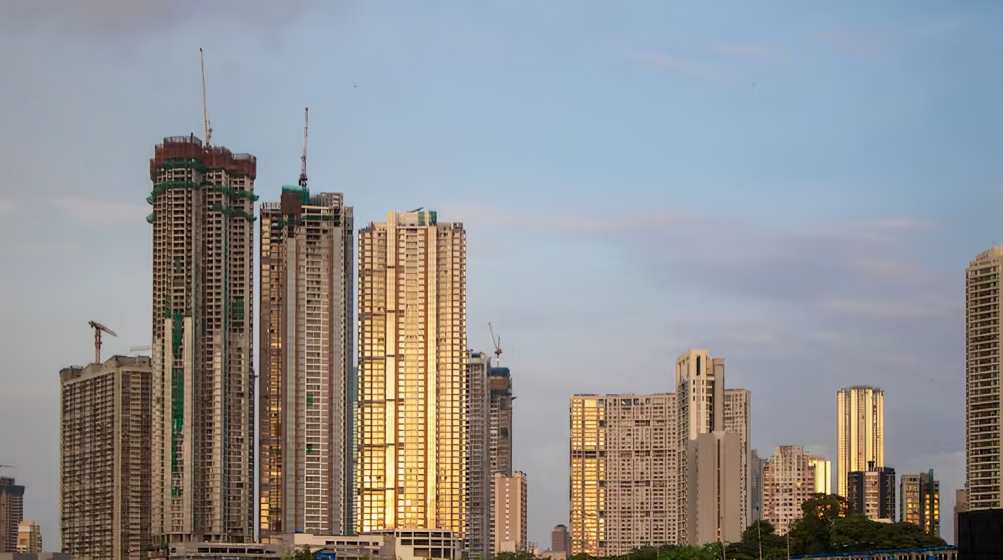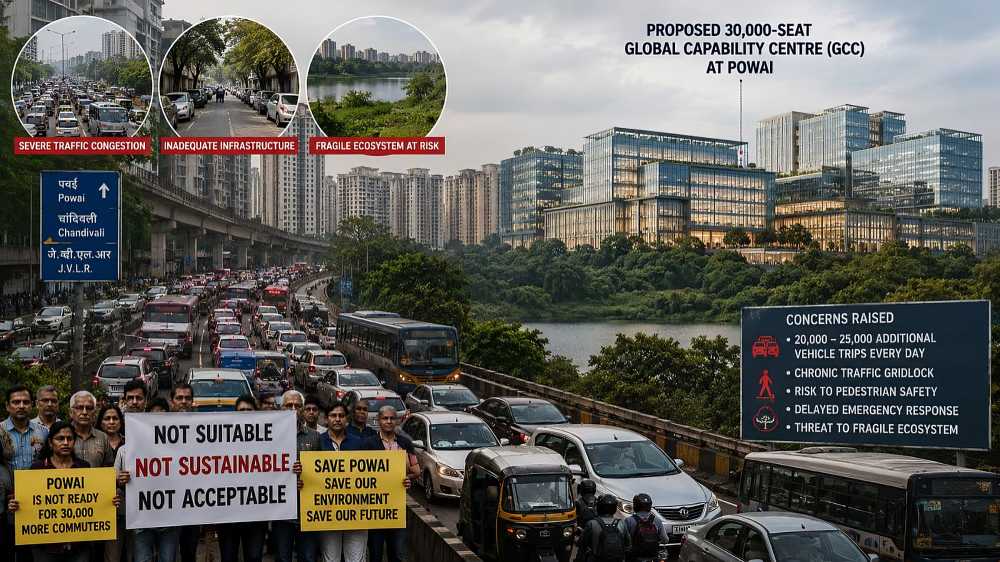

Residents, housing societies and citizen groups in Powai have opposed plans for a proposed 30,000-seat Global Capability Centre (GCC), arguing that the large-scale commercial development could place severe pressure on the suburb’s already stretched infrastructure and environmentally sensitive landscape.
In a representation submitted to Maharashtra Chief Minister Devendra Fadnavis, the Powai Area Locality Management (ALM) along with 15 cooperative housing societies expressed concerns over the proposed two-million-square-foot campus planned within the Powai-Chandivali residential zone. The groups described the project as a “public and ecological disaster in the making” and urged authorities to reconsider its location.
According to residents, the area was originally developed under the Powai Area Development Scheme as a residential township and lacks the infrastructure needed to accommodate a project of this magnitude. The representation further characterised the proposal as “a mass casualty event waiting to happen”, citing traffic congestion, inadequate road capacity and limited emergency evacuation options.
Residents pointed out that the internal road network in Powai and Chandivali largely consists of narrow two-lane roads that are already struggling to handle existing traffic volumes. They argued that the addition of thousands of employees, private vehicles, buses, cabs and service traffic associated with the GCC would significantly worsen congestion.
The Jogeshwari-Vikhroli Link Road (JVLR), which serves as the primary arterial connection to Powai, is already operating under heavy traffic conditions. Peak-hour travel between the Western Express Highway and Powai frequently extends close to an hour, while vehicle movement within Hiranandani Gardens and surrounding neighbourhoods remains challenging.
Citizen groups estimate that the proposed facility could generate between 20,000 and 25,000 additional vehicle trips every day, potentially leading to persistent traffic bottlenecks across the Powai-Chandivali corridor.
“Powai’s roads are already stretched far beyond their intended capacity. Residents routinely spend 30 to 45 minutes navigating distances that should take less than 10 minutes during peak hours,” said Pamela Cheema, chairperson of the Powai ALM.
“Adding a 30,000-employee campus to this already overburdened ecosystem would turn daily commuting into a nightmare and severely compromise pedestrian safety and emergency response times. This is no longer just a question of inconvenience or longer commute times. Powai is staring at a full-blown infrastructure and environmental crisis,” said Milan Bhat, a member of the Powai ALM.
Environmental groups, including NatConnect Foundation, have also voiced concerns, warning that the project could adversely affect Powai’s fragile ecological balance.
Source: The Free Press Journal