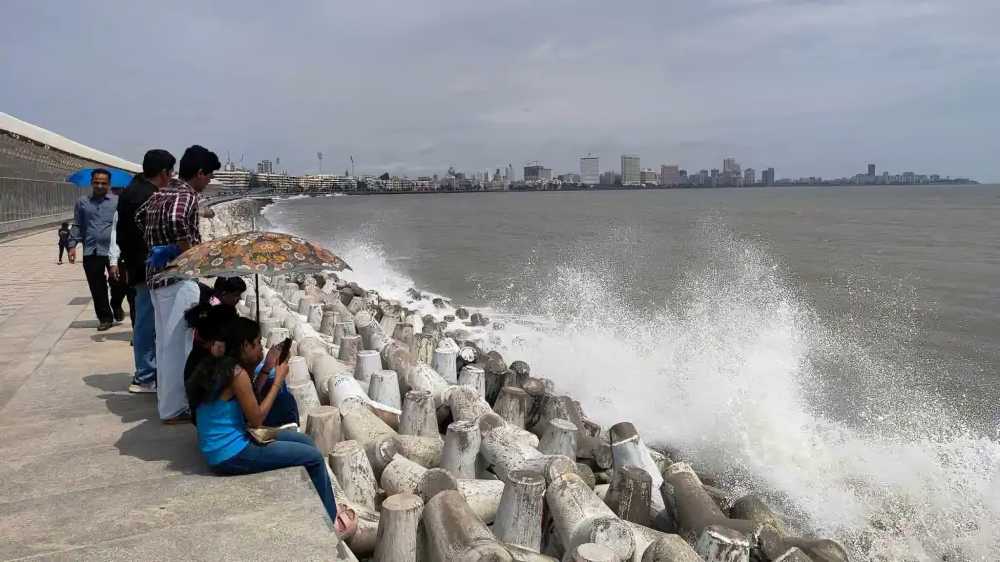

The Brihanmumbai Municipal Corporation (BMC) has initiated a fresh assessment of Mumbai’s vulnerability to rising sea levels, examining how coastal development, changing land use and evolving climate patterns could affect the city’s 149-km shoreline.
The study is the civic body’s second major sea-level risk assessment in five years and is expected to identify vulnerable coastal stretches, inhabited areas facing potential inundation and changes in risk levels. The assessment is expected to be completed and released next year.
The exercise comes amid increasing global concern over rising sea levels. A recent United Nations assessment reported that global sea levels increased by 5.9 mm in 2024 and projected a rise of at least 0.5 metre by 2100 even under ambitious emissions-reduction scenarios. Under a worst-case scenario involving instability of the West Antarctic ice sheet, the increase could reach around two metres.
A senior civic official said Mumbai’s coastline had undergone substantial changes in recent years, making an updated assessment necessary.
“Over the last five years, Mumbai’s shoreline has seen a massive transformation. The Coastal Road has come up along the western seafront, with more than 100 hectares of the Arabian Sea reclaimed. On the eastern side, salt pan lands have been identified for development. There has also been a change in the overall land-use pattern. Therefore, a fresh risk assessment was needed,” the official said.
Scientists have associated rising sea levels with global warming and increasing sea surface temperatures. The 2022 Mumbai Climate Action Plan (MCAP) noted changes in Arabian Sea temperatures over the previous two decades.
“While the analysis of annual mean SST between 2003 and 2020 shows an absence of a statistically significant trend in sea level variations, a slight steady increase of 0.025°C per year for daytime SST and 0.019°C per year for nighttime SST has been observed,” the report stated.
Raghu Murtugudde, emeritus professor at the University of Maryland and visiting professor at IIT Bombay, said changing rainfall patterns and higher temperatures were adding to Mumbai’s flood risks.
“Over the past few years, we have seen rainfall patterns becoming more erratic, with Mumbai recording above-normal rainfall. Heavy rainfall and high tidal waves are working as a combined factor leading to inundation of Mumbai, posing a heavy risk to people living in the island city,” he said.
Climate scientist and oceanographer Roxy Mathew Koll of IITM said the city’s geography and development pattern were also contributing to its vulnerability.
“Rapid development, concretisation and land-use changes shrink floodplains and congest rivers. The Bandra Kurla Complex was built on mangrove land, while the Mithi River was reduced to a nallah due to roads and encroachment. Mumbai floods are more of a management problem due to unplanned development rather than a climate change problem,” he said.
Koll stressed that protecting mangroves and coastal wetlands would be essential for strengthening Mumbai’s resilience.
“Mangroves and floodplains have traditionally acted as the lungs of the city, protecting it from flood water and strong winds. Protecting and expanding these coastal wetlands can significantly enhance Mumbai’s resilience to sea-level rise while providing safe habitats for biodiversity and marine life,” he said.
The MCAP has also documented changes in Mumbai’s mangrove cover between 2008 and 2021. Around 325 hectares of dense mangroves reportedly became sparse or converted into intertidal mudflats due to erosion and sedimentation, while mangrove density increased across about 305 hectares.
The new assessment is expected to provide the BMC with updated data on Mumbai’s coastal exposure and help inform planning decisions as the city continues to expand along its vulnerable shoreline.
Source: The Indian Express