
The proposed redevelopment of Simplex Housing Condominium in Ghansoli has triggered a wider debate in Navi Mumbai over balancing the need for larger homes with the ability of existing infrastructure to support greater population density.
Maharashtra Deputy Chief Minister and Urban Development Minister Eknath Shinde has backed the proposed cluster redevelopment, while Forest Minister Ganesh Naik has raised concerns over the impact of higher floor space index (FSI) on water supply, transport, parking, sewage and other civic systems.
Speaking during the Navi Mumbai Dahikala Utsav 2026 in Ghansoli on September 5, Shinde said redevelopment could provide residents currently living in compact one-room-kitchen and one-bedroom homes with larger houses. Referring to cluster redevelopment in Thane, he said similar benefits could be delivered to residents of Navi Mumbai.
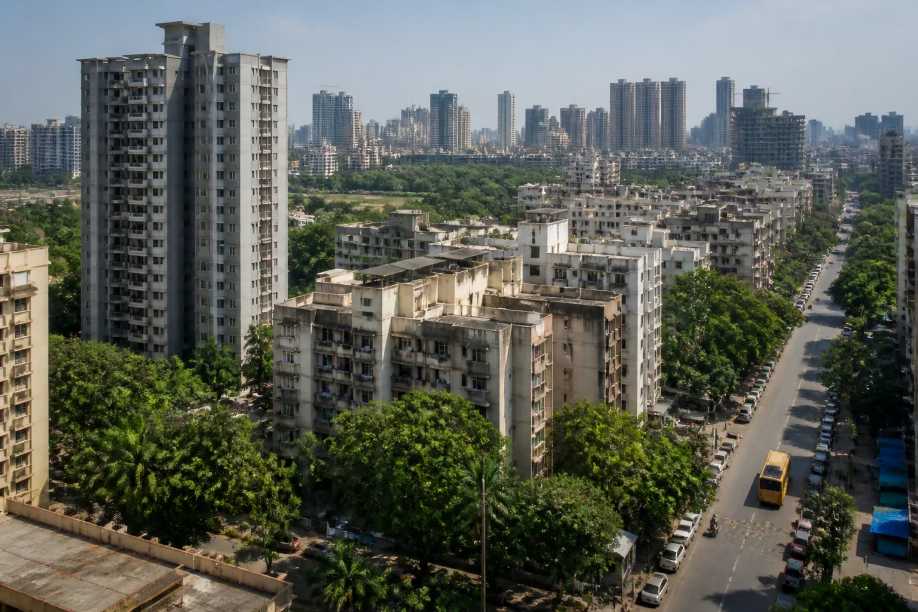
The proposal concerns Cluster Number Four, covering approximately 67,146 sq. m in Sector 7, Ghansoli. Following a recommendation by a high-powered committee on June 17, Navi Mumbai Municipal Corporation Commissioner Dr Kailas Shinde issued a notification on July 14 inviting suggestions and objections from residents and other stakeholders.
FSI Becomes Central to the Debate
FSI determines the amount of construction permitted on a given plot. Higher FSI can make redevelopment financially viable while allowing developers to provide larger rehabilitation homes and recover project costs through additional development.
However, greater construction density can also place additional pressure on roads, parking, water networks, sewage systems, public transport and open spaces.
Naik and members of the ruling BJP group in the municipal corporation have reportedly sought a scientific assessment of the likely impact of increased FSI. The cluster proposal has reportedly been kept on hold pending such a study.
The available information does not yet specify the final FSI, proposed number of homes, expected population increase or the detailed findings of an infrastructure-capacity assessment.
Housing Needs Versus Infrastructure Capacity
Supporters of the project argue that redevelopment can improve living conditions for residents of ageing or inadequately planned housing by providing modern homes and better amenities. Critics, however, want infrastructure capacity to be assessed before additional density is approved.
Unlike individual-building redevelopment, a cluster project involves a larger area and can reshape roads, open spaces, utilities and population distribution across an entire neighbourhood.
The Ghansoli proposal therefore goes beyond replacing old structures. Its success will depend on whether housing improvements can be matched by adequate civic infrastructure.
The next key steps will include the outcome of the proposed infrastructure study, the municipal authority’s response to public objections and clarification of the project’s final development parameters.
For Navi Mumbai, the Simplex Housing Condominium redevelopment has become an important test of whether higher density can be accommodated without placing excessive pressure on the city’s existing infrastructure.
Source: Urban Acres