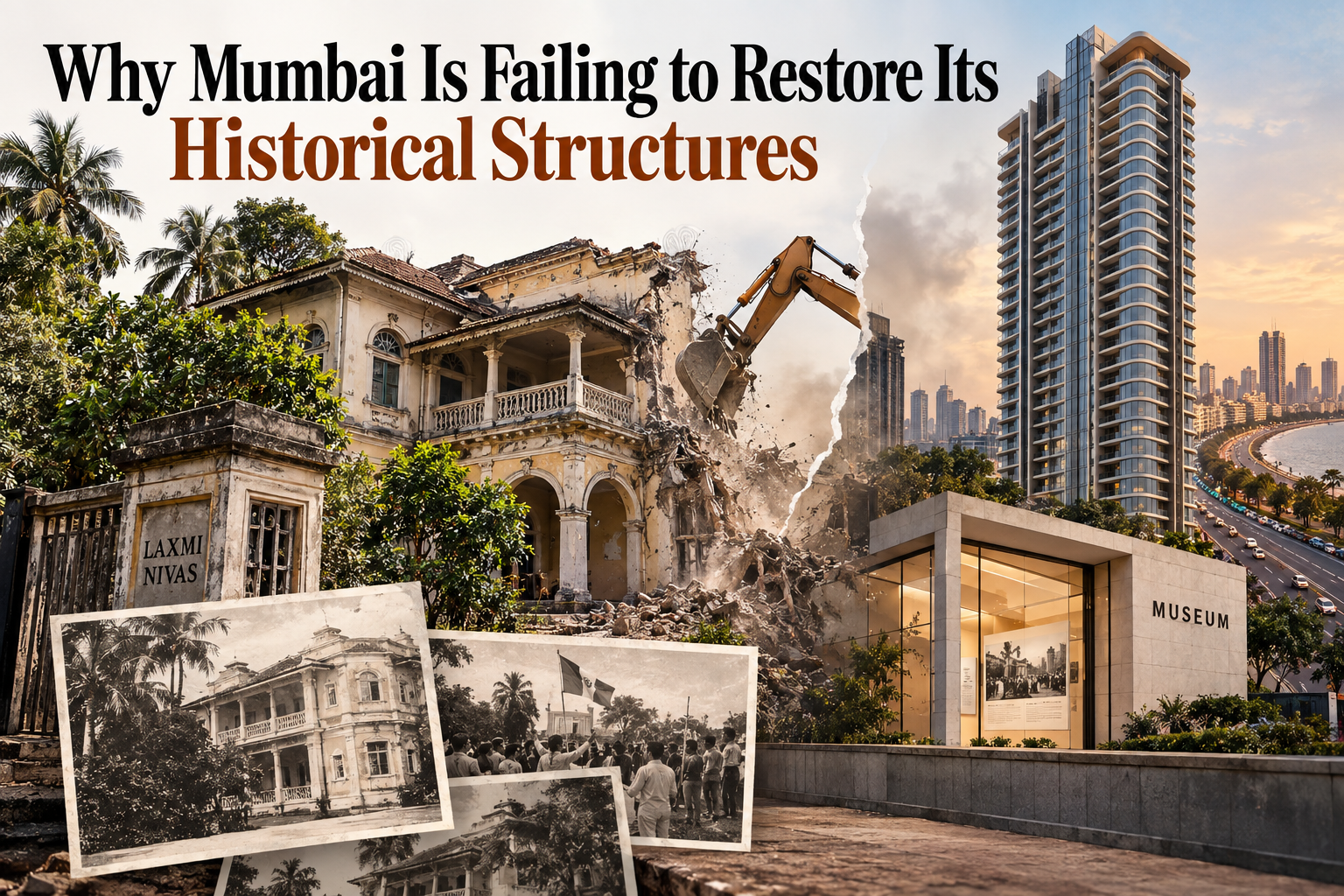

Mumbai has quietly redefined what it means to “preserve” a heritage building: take a few photographs, build a small museum, and then bring in the bulldozer.
That, at least, is the model being proposed for Laxmi Nivas, the century-old Nepean Sea Road bungalow linked to underground leaders of the Quit India Movement. The Kapadia family bought it in 1917 for about Rs 1.20 lakh. It recently changed hands for Rs 276 crore. In its place: a 110.6-metre residential tower, with a small ground-plus-one museum thrown in to house the memories.
Fair enough, one could say. Land in South Mumbai is scarce, families cannot be expected to run a heritage trust out of their own bungalow, and the city genuinely needs housing.
But Mumbai’s residents are entitled to ask a rather inconvenient question: when did “preserve the story” start meaning the same thing as “demolish the building”?
Because a museum can display an old photograph. It cannot recreate the room the photograph was taken in.
And Laxmi Nivas is not an isolated case. It is simply the most expensive example of a pattern the city has normalised.
In Khotachiwadi, the nearly 200-year-old Girgaum precinct, the BMC issued a stop-work notice in 2022 after part of a heritage bungalow, Fernandez House, was quietly demolished without permission. Residents demanded FIR. The civic body’s own heritage rules were, in theory, already protecting that structure. In practice, they arrived only after part of it was gone.
Along Marine Drive, home to one of the world’s largest Art Deco collections and a UNESCO World Heritage precinct, owners are increasingly eager to redevelop. Conservationists warn that enough mismatched towers could quietly erode the very character that got the precinct its global tag in the first place. Nobody needs to demolish a UNESCO site to lose it. Diluting it building by building works just as well.
None of this is an argument against redevelopment itself. Mumbai’s own data shows redevelopment proposals surging across the city, and that is broadly a good thing: more housing, safer buildings, better use of scarce land. Old age alone is not a reason to freeze a structure in place.
But age and heritage are not the same thing, and right now the city applies almost no filter between the two. A structure of genuine historical value should have to clear one question before demolition is even discussed: can it be restored, reused, or built around — not just remembered?
Mumbai already has the answer sitting in plain sight. The Royal Opera House was shuttered and crumbling through the 1990s before a six-year restoration reopened it in 2016 as a working 575-seat theatre — chandeliers, baroque ceilings and all, not replicated but retained. In the Fort area, the century-old Ismail Building now houses a retail store, and the Sassoon Building near Jehangir Art Gallery now houses a fashion flagship. Old shell, new business, no demolition required.
If a theatre and two commercial buildings can pull this off, a residential tower on Nepean Sea Road should not need a museum to make peace with its own conscience.
Mumbai doesn’t need more plaques, more photo archives, or more ground-plus-one memorial museums. It needs a redevelopment process that asks the adaptive-reuse question before the demolition notice, not after.
Because a city that keeps photographs and loses the buildings isn’t really preserving its heritage.
It’s just archiving its own disappearance — one museum at a time.