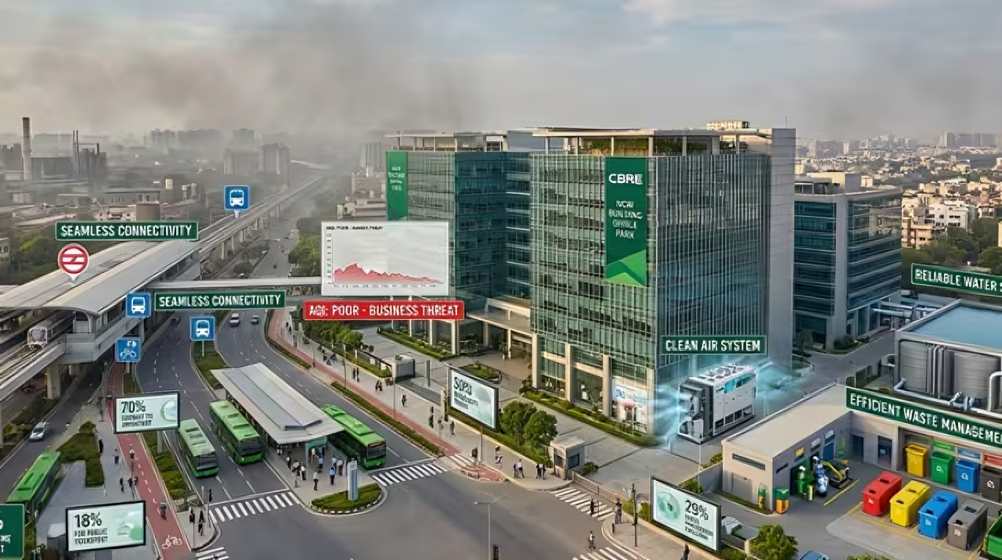

Office location decisions are increasingly being influenced by factors beyond the quality of the workspace itself, with 70% of companies considering commute and connectivity among their most important criteria when selecting commercial property, according to a new CBRE report.
The report, Commute Counts, released on September 15 as part of CBRE South Asia’s Inside the Occupier Mind series, found that employee travel time is a significant consideration for nearly seven in 10 office occupiers. Around 18% of companies said they would pay a premium for properties with better public transport access, highlighting the growing importance of connectivity in commercial real estate.
Infrastructure challenges are also affecting business decisions. Poor air quality and AQI levels were identified by half of the occupiers surveyed as a major threat to business operations and employee experience. Water availability and quality were concerns for 31%, while 29% cited waste management and sanitation as potential productivity risks.
Commute Moves Beyond Convenience
“As India’s cities grow denser and commutes grow longer, occupiers are effectively counting it in their leases,” said Anshuman Magazine, chairman and CEO – India, South-East Asia, Middle East & Africa, CBRE. “Infrastructure access now sits at the centre of where and how corporates choose to locate their businesses. For developers and city administrations alike, this is a clear signal that connectivity investment and commercial real estate value are now inseparable.”
Ram Chandnani, Managing Director, Leasing Services, India, CBRE, said, “Commute has moved from being a convenience factor to a non-negotiable one. Occupiers are telling us clearly that access to transit, talent, and reliable last-mile connectivity now shapes real estate decisions as much as rent or location prestige. In several transactions we are advising on, transit proximity is being weighed at the shortlisting stage itself, well before commercial terms are discussed.”
Mumbai’s Transit Expansion Could Influence Leasing
The report noted that infrastructure upgrades such as metro networks and road projects are opening new opportunities for commercial real estate across major Indian cities.
In Mumbai, the planned completion of Metro Line 2B (DN Nagar–Mandale), Line 4 (Wadala–Kasarvadavali) and Line 6 (Lokhandwala–Vikhroli) by 2027 could strengthen leasing prospects across major employment corridors such as Worli, Bandra-Kurla Complex (BKC) and Powai.
Improved connectivity could make these locations more accessible to employees while supporting occupiers seeking access to a wider talent pool.
Infrastructure Shapes Emerging Business Districts
Similar trends are visible outside Mumbai. In Delhi-NCR, upcoming metro and expressway projects are generating interest in better-connected commercial locations. In the south, Chennai’s Peripheral Ring Road and airport-related developments around Pune are expected to create opportunities in emerging, relatively cost-effective submarkets.
For developers and investors, the findings suggest that transport connectivity, employee accessibility and quality-of-life infrastructure are becoming increasingly intertwined with office valuations.
As companies reassess workplace strategies and employees place greater importance on manageable commutes, commercial buildings located close to reliable public transport could command a competitive advantage.
The report ultimately points to a broader shift in Indian commercial real estate: location is no longer defined simply by where an office stands, but by how easily people can reach it and how well the surrounding city supports everyday work life.
Source: RP Realty Plus