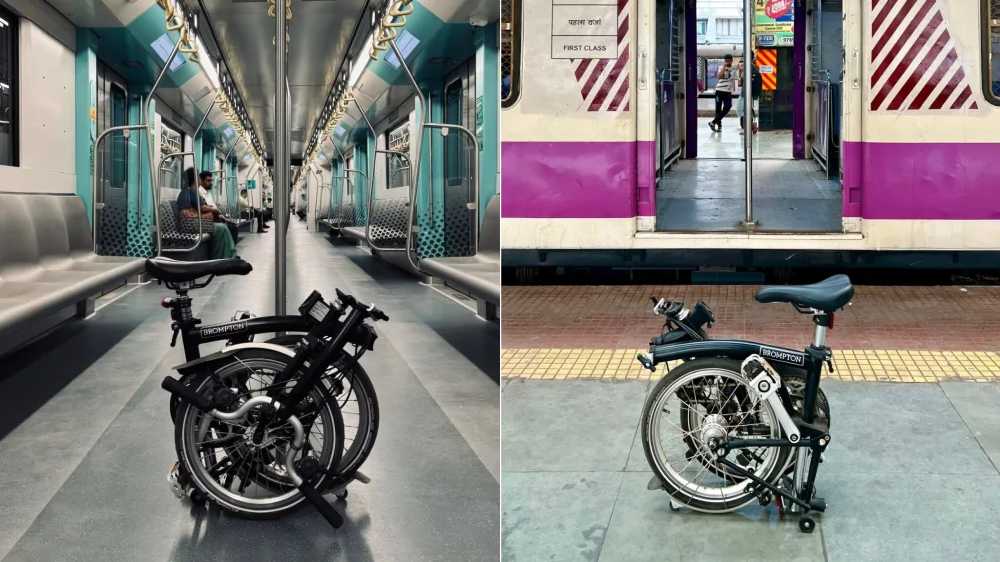

Mumbai’s Metro Line 3, or Aqua Line, has come under scrutiny from urban planners and cycling advocates over its policy prohibiting commuters from carrying bicycles, including foldable models, on the underground corridor.
The issue surfaced after architect Pranav Naik, who had regularly travelled with a folding bicycle between his office in Mahim and project sites in Fort, said he was recently stopped from taking it onto the Metro despite having done so for nearly a year.
“I was stopped out of the blue, despite having taken the cycle countless times before it. Guards and the officials of the metro told me that a new rule meant I couldn’t take my cycle in,” said Naik, who is the cofounder of Studio Pomergrante. “While they eventually let me, they didn’t have any explanation as to why it isn’t allowed, if other similarly sized bags and wheelchairs are allowed.”
MMRCL Confirms Restriction
The Mumbai Metro Rail Corporation Limited (MMRCL) has confirmed that bicycles are prohibited on Metro 3, whether they are folded or packed.
It said, “As per the prevailing security guidelines, bicycles, including foldable bicycles in folded or packed condition, are not permitted on Mumbai Metro Line 3 (Aqua Line) premises or trains.”
The rule is not new, according to MMRCL, which said the line was designed to handle a large passenger volume. However, concerns have been raised over whether restrictions on bicycles could limit opportunities for sustainable first- and last-mile travel.
Naik said he has used bicycles on Mumbai’s suburban trains and other Metro corridors without encountering similar restrictions.
Cycling Advocates Raise Multimodal Transport Concerns
Firoza Dadan, Mumbai’s first bicycle mayor, said foldable cycles could help commuters bridge the gap between Metro stations and their final destinations.
“A folding bicycle is a practical solution for first and last mile problems. Otherwise, you’re increasing the dependency on shared mobility, like rickshaws, taxis, cab-hailing apps. If the authorities are saying they’re working towards sustainable public transport in the city, why are they skipping out on this one piece that could help?”
The absence of convenient last-mile options can make switching from Metro stations to another mode of transport difficult for commuters, particularly where waiting times, availability and fares vary.
Vijay Malhotra, Cycling Blogger & Founder of Pedal and Tring Tring, said the restriction could undermine the broader objective of integrated public transport.
“Restricting folding bicycles on the Aqua Line dilutes the core purpose of building a multi-modal transport system. For a modern infrastructure like Line 3 to succeed in promoting green commuting, MMRCL must integrate folding bikes into its transit policy and align with other metro lines in the city,” said Vijay Malhotra, Cycling Blogger & Founder of Pedal and Tring Tring.
Debate Over Metro and Last-Mile Connectivity
Metro systems are typically intended to form part of a wider transport network, linking with trains, buses, walking and other modes. In Mumbai, where stations can be located some distance from offices and residential areas, foldable bicycles can offer commuters another way to complete their journeys.
The debate over Metro 3’s bicycle policy therefore centres not only on carrying cycles inside trains but also on how Mumbai plans to build a more connected, sustainable and multimodal transport system.
As the Aqua Line expands its role in the city’s public transport network, planners and cycling advocates are seeking greater clarity on whether its rules can accommodate emerging forms of last-mile mobility while maintaining security and passenger-management requirements.
Source: The Indian Express