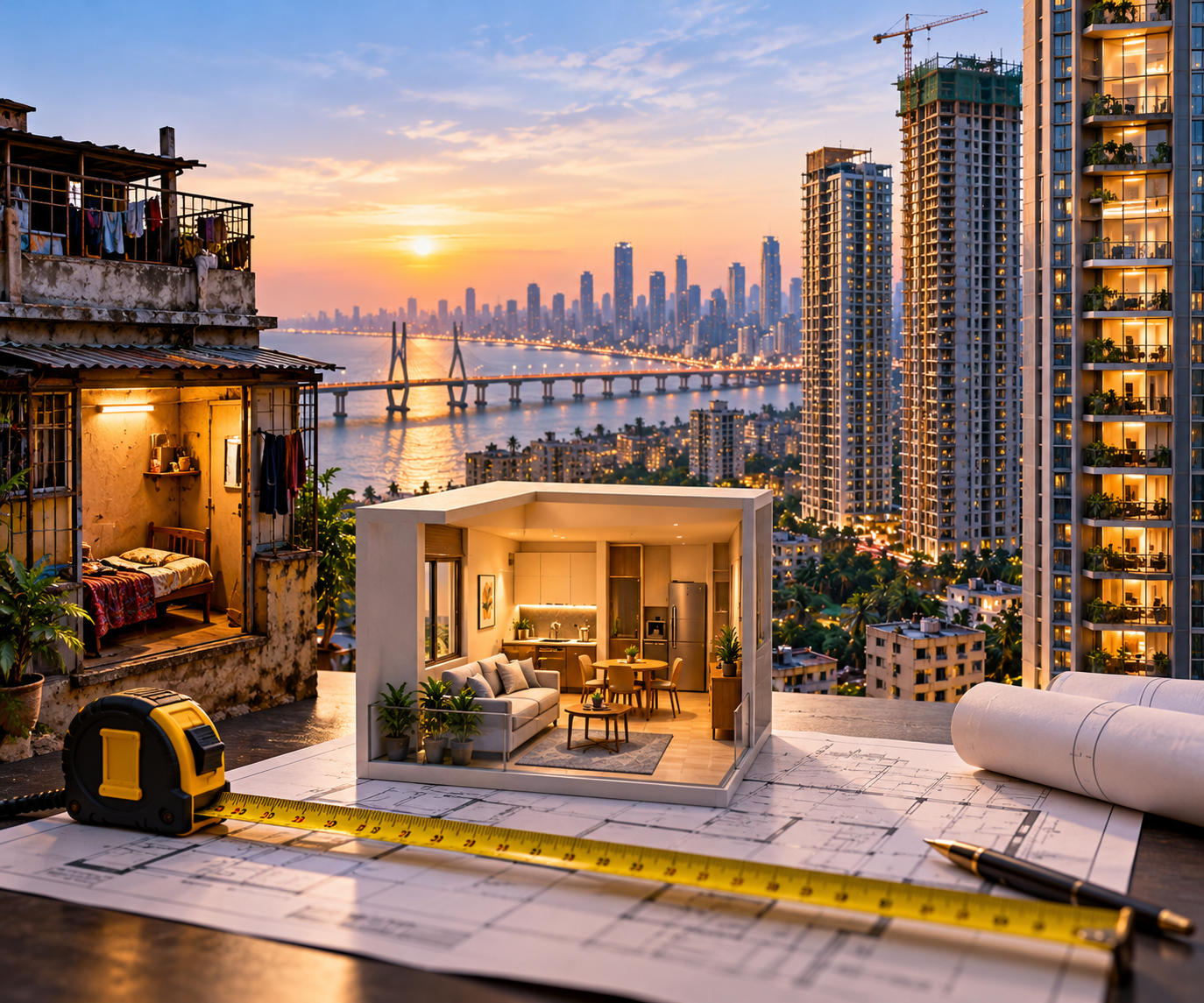

Mumbai has turned the square foot into the most important character in its real estate story.
In most cities, a home is described by its bedrooms. In Mumbai, it is increasingly described by its carpet area. The reason is simple: when land is scarce and redevelopment becomes the primary way to create new housing, every additional square foot carries a distinct economic value.
Out of this scarcity, Mumbai has developed a peculiar form of urban mathematics. The building gets taller. The family gets a newer home. The developer gets additional saleable area. And somewhere in the middle, everyone ends up negotiating over 50 square feet.
The numbers tell a more complicated story than the familiar “Mumbai homes are getting smaller” narrative.
A City of Many Housing Markets
Knight Frank’s redevelopment study estimates that 910 society redevelopment deals signed between 2020 and H1 2025 could potentially generate around 44,277 new residential units. But the estimated average saleable unit size varies dramatically by location — around 1,200 sq ft in South Mumbai, 1,000 sq ft in Central Mumbai, and just 700 sq ft in the western and central suburbs.
So Mumbai does not have one housing market. It has a geography of square feet. The same city considers 700 sq ft perfectly marketable in one neighbourhood and treats 1,200 sq ft as merely comfortable in another.
Then comes the price of that space. ANAROCK’s Q1 2026 MMR data shows the market spread across several price bands: 22% of supply priced below Rs 40 lakh, another 20% between Rs 40 lakh and Rs 80 lakh, and 20% between Rs 80 lakh and Rs 1.5 crore. At the other end, 12% of supply was priced above Rs 4 crore.
This tells us something important: Mumbai’s real estate problem is not simply a shortage of homes. It is a shortage of appropriately priced space in appropriately located homes.
A 700 sq ft apartment near employment centres can be more valuable to a household than a much larger home several hours away — which is why the city’s obsession with square footage sometimes misses the larger point. A square foot has no value in isolation. Its worth depends on where it is, what it costs, and how much of life can actually fit around it.
Redevelopment Adds a New Variable
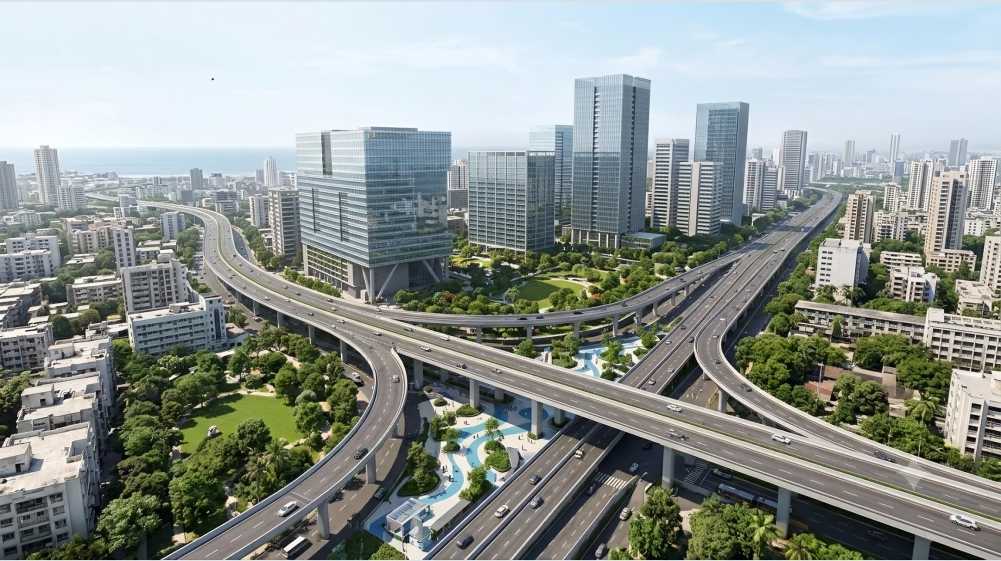
Redevelopment is making that calculation even more interesting. Mumbai’s DCPR-2034 framework allows additional development potential across several redevelopment models, effectively enabling the city to accommodate more floor space without expanding its geographical footprint.
The result is a city trying to solve its land shortage by adding density. But density has consequences. More homes mean more residents using the same roads, schools, water systems, open spaces, and public infrastructure — the part of the square-foot calculation that rarely appears in a property brochure.
A Widening Market
The market is also becoming more expensive at the upper end. Knight Frank recorded a 17% year-on-year increase in sales in the Rs 2–5 crore segment nationally in Q1 2026, while the Rs 10–20 crore segment rose 12%.
So Mumbai is doing two things at once: making urban housing increasingly compact for the mass market, while creating increasingly expensive larger homes for those who can afford them.
The Real Paradox
Perhaps that is the real paradox. Mumbai is not running out of housing. It is running out of cheap space — and that distinction matters, because a city can keep adding floors indefinitely, but it cannot keep adding affordability at the same speed.
The next great innovation in Mumbai real estate, therefore, may not be a taller tower or a bigger clubhouse. It may simply be figuring out how to make every square foot count for the person living inside it.
After all, in Mumbai, space was never really a luxury. The luxury was being able to afford enough of it.