
Mumbai has found a remarkably efficient way of making space.
Demolish something old. Build something new. Put up a glossy hoarding. Call it redevelopment.
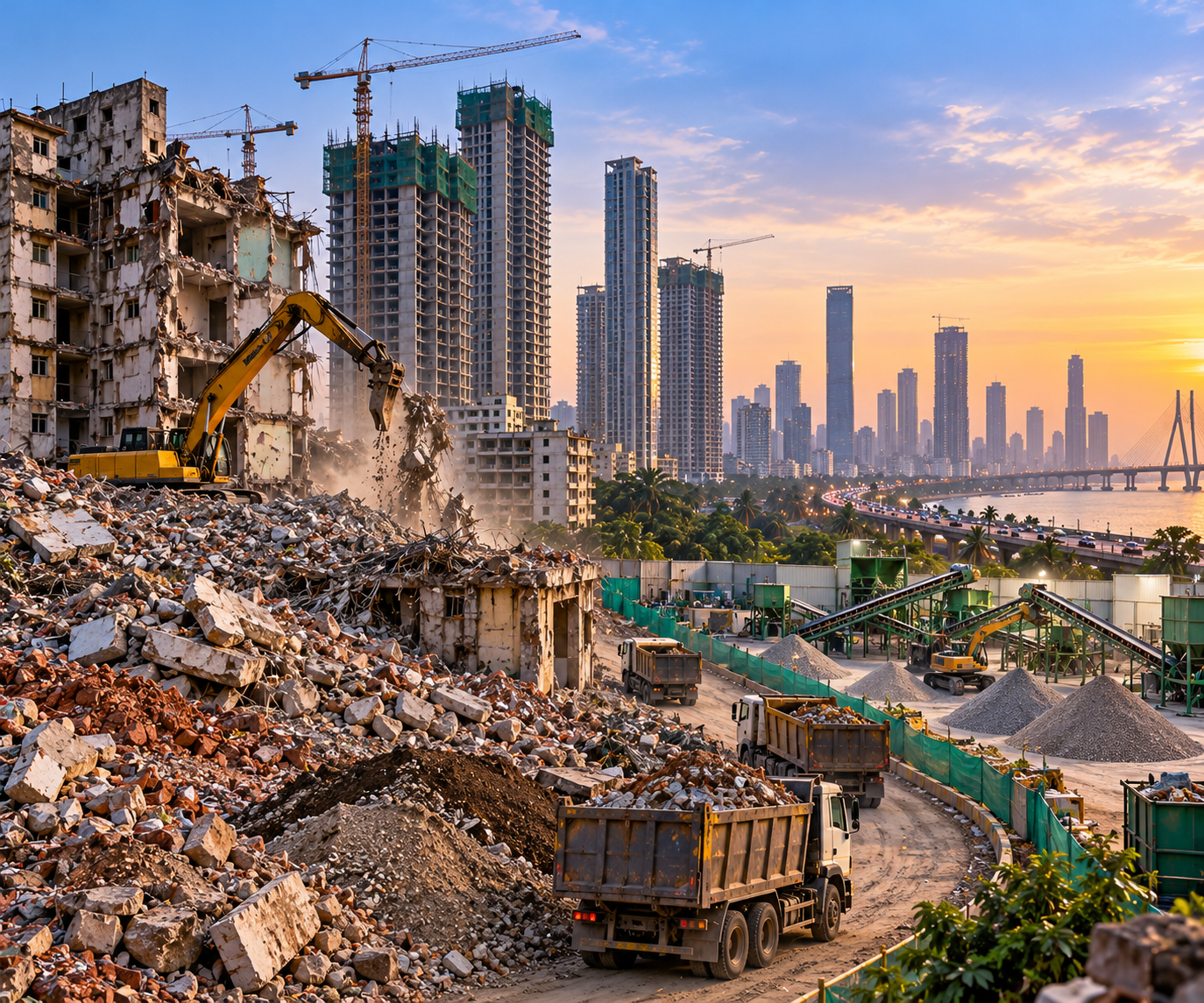
There is, however, one small detail between the demolition and the possession letter: the rubble. And Mumbai has a lot of it.
The city’s real estate boom has an unglamorous side effect. Buildings disappear, towers appear, and somewhere in between, thousands of tonnes of concrete, bricks, plaster, soil and other construction debris need to find a new address.
According to the BMC’s latest 2026 figures, Mumbai generates more than 8,000 tonnes of construction and demolition waste every day. That is actually more than the city’s daily municipal solid waste generation of around 6,500 tonnes recorded by the BMC in its 2026 Civic Diary.
So Mumbai has managed to create a rather unusual situation: the city is producing more waste while constructing buildings than it does from the people actually living in them.
And the city’s ability to process this mountain is considerably smaller.
The BMC currently has two C&D waste processing facilities at Dahisar and Daighar, with a combined capacity of 1,200 tonnes per day.
Do the simple math and Mumbai is generating roughly 6.7 times more C&D waste than the current capacity of these two facilities.
That leaves quite a lot of rubble looking for somewhere to go. To be fair, the BMC is no longer pretending that the problem will disappear on its own.
In 2026, it launched an online tracking system covering C&D waste from the point it is generated to its final disposal. Builders, contractors, government agencies and even residents carrying out repairs are covered by the system. Vehicles transporting debris are being tracked, while violations can attract penalties of up to ₹25,000 per vehicle.
The BMC has also been pushing recycling. Its C&D programme currently promotes recycled aggregates, sand, paver blocks and kerbstones instead of treating every demolished building as something that simply needs to be carted away.
That is important because Mumbai’s rubble is not necessarily rubbish.
Concrete can become recycled aggregate. Excavated soil can potentially be reused. Processed debris can return to construction as sand substitutes, paver blocks and other materials.
In fact, the BMC’s own climate budget notes that the existing 1,200-tonne-per-day plants can process C&D waste into reusable construction material.
But here comes the slightly embarrassing part.
Mumbai currently generates more than 8,000 tonnes every day, while its existing civic processing capacity stands at 1,200 tonnes a day.
The city is, essentially, demolishing at Formula One speed and recycling at bicycle speed.
The BMC is now looking to expand capacity. As of October 2026, its tendering process includes an integrated C&D waste processing facility with a total proposed capacity of 2,000 tonnes per day across three locations.
That would help. But capacity is only half the story. The other half is movement.
A demolished building in South Mumbai does not disappear. It travels. And rubble, unlike a luxury apartment brochure, does not teleport.
Every kilometre means another truck, another diesel bill, another stretch of road occupied and another opportunity for illegal dumping.
That is why C&D waste should stop being treated as the annoying final chapter of a redevelopment project. It is a material stream.
Mumbai’s developers are already experts at turning old plots into new towers. The next challenge should be turning old buildings into new building material too.
Because there is something almost perfectly Mumbai about the current cycle.
Demolish yesterday’s building. Transport yesterday’s building somewhere else. Process a fraction of yesterday’s building. Then use virgin material to build tomorrow’s building. Repeat.
The city’s real estate story has always been obsessed with what rises from the ground: taller towers, newer homes, bigger projects and shinier skylines.
Perhaps it is time to pay equal attention to what gets left behind. Because Mumbai’s skyline is going vertical. Its waste problem is going everywhere else.