
The Mumbai Metropolitan Region Development Authority (MMRDA) has completed three Existing Land Use (ELU) reports in just two-and-a-half months, covering around 2,008 sq km and 565 villages across Raigad and Palghar. The exercise is intended to provide a data-driven base for future master planning, infrastructure expansion, housing and environmental management.
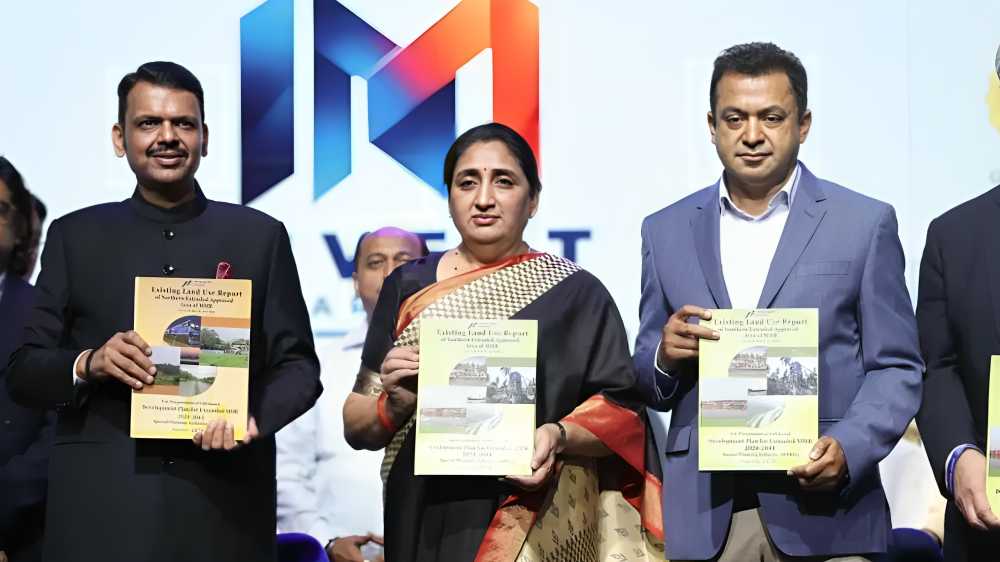
The reports cover KSC New Town, Northern Extended Notified Area (ENA) in Palghar and Southern ENA in Raigad, including Alibag. MMRDA Commissioner Dr Sanjay Mukherjee handed the reports to Maharashtra Chief Minister Devendra Fadnavis during the launch of Invest Maharashtra on October 3.
The authority used aerial LiDAR, high-resolution imagery, DGPS surveys and GIS mapping, along with cadastral records and field verification, to document settlements, infrastructure, terrain, natural systems and existing land-use patterns.
The KSC New Town report covers 324 sq km and 124 villages in Pen, Uran and Panvel. With major projects such as Navi Mumbai International Airport, JNPA, Atal Setu and the Virar-Alibaug Multi-Modal Corridor, the area is emerging as a key metropolitan growth centre.
The Northern ENA spans 1,007 sq km and 224 villages in Palghar, encompassing forests, rivers, agricultural areas, mangroves, wetlands, tribal settlements and a 40-km coastline. The Southern ENA covers 677 sq km and 217 villages, including Alibag.
MMRDA plans to use the database for digital twins and scenario modelling, allowing authorities to assess infrastructure demand, mobility, flood risks and service access before major investments.
The planning framework will identify locations for employment hubs, logistics, commercial districts, digital infrastructure and affordable housing. MMRDA said, “Improved connectivity and phased infrastructure development could attract investment, generate employment and create opportunities for enterprises and skills development.”
Around 45 per cent of the combined study area falls under forest and green-area categories. Environmental protection will therefore remain central to future development.
Fadnavis said, “By bringing transport, employment, housing and environmental protection into one coordinated planning approach, we can spread opportunity across the metropolitan region. Our aim is to attract investment, create jobs and improve quality of life as MMR drives Maharashtra’s progress towards a USD 1 trillion economy,” Fadnavis said.
MMRDA Commissioner Sanjay Mukherjee said, ” Our goal is to create compact, connected centres where people can live closer to work, learning, healthcare and recreation, with greater access to open spaces and stronger climate resilience. This is the foundation for a more liveable MMR.”
Source: Mid-day