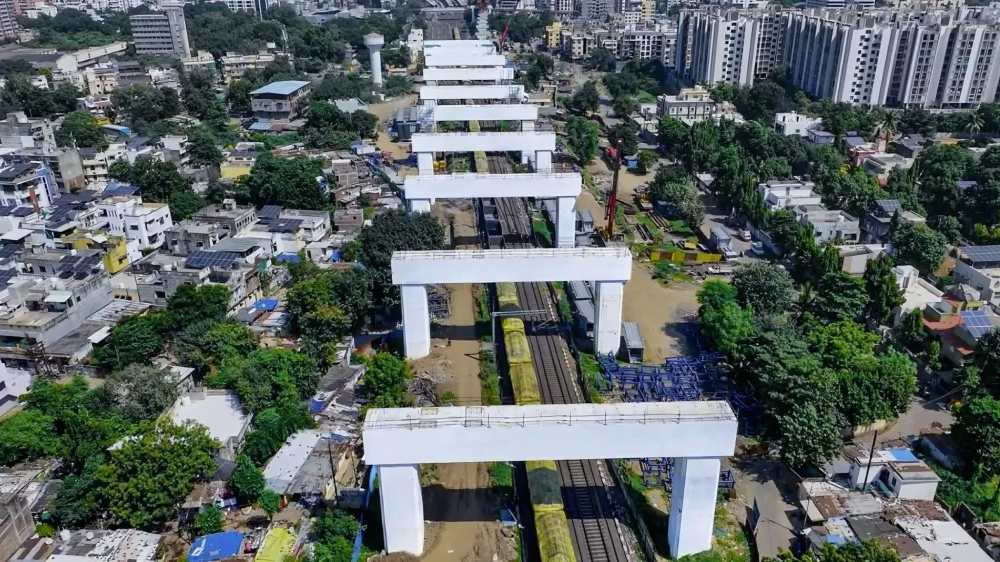

The Mumbai–Ahmedabad High-Speed Rail project has reached a significant construction milestone in Vadodara, Gujarat, with the installation of all 14 portal beams above the operational Delhi–Mumbai Rajdhani railway line. The achievement paves the way for the next phase of work on the elevated corridor for India’s first bullet train service.
The National High Speed Rail Corporation Limited (NHSRCL), which is implementing the project, said the construction involved considerable engineering and logistical complexities because the work was undertaken over an active railway route.
The Vadodara section of the high-speed rail alignment extends for approximately 8.3 km and crosses five Indian Railways lines, including two main lines. The route passes diagonally over the heavily used Delhi–Mumbai Rajdhani corridor, making the construction process particularly challenging.
With the portal beams now in place, the project’s next stage will involve positioning 40-metre-long composite girders to extend the elevated viaduct.
“Their completion clears a major structural requirement for launching the 40-metre composite girders over the Rajdhani main line and advancing the elevated corridor through this critical section,” it added.
Portal beams are substantial structural elements that support elevated railway viaducts, particularly where new rail corridors intersect existing railway infrastructure. At Vadodara, engineers adopted a cast-in-situ construction method to accommodate restricted space and operational railway requirements.
“The portal beams have been constructed using the cast-in-situ method, necessitated by the highly constrained locations and the need to work around operational railway infrastructure,” the NHSRCL said.
Each portal beam weighs around 1,500 tonnes and measures approximately 37 metres in length, four metres in height and four metres in width. Its construction required nearly 590 cubic metres of concrete and a reinforcement steel cage weighing about 55 tonnes.
The remaining work will require specialised heavy-duty cranes, hydraulic jacks, concrete pumps and precision surveying equipment. According to NHSRCL, execution above active railway lines demands careful scheduling, continuous monitoring and coordination with Indian Railways, alongside controlled railway blocks wherever necessary.
The milestone brings the project closer to completing another section of the elevated infrastructure connecting Mumbai and Ahmedabad.
Source: The Indian Express