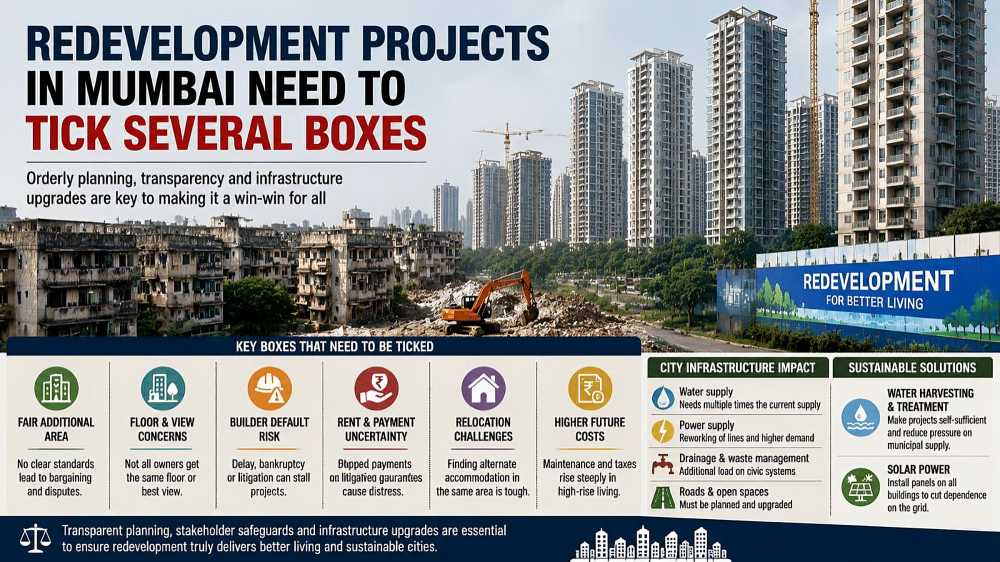

Redevelopment has emerged as a key driver of Mumbai’s urban transformation, with ageing residential buildings making way for modern high-rises offering larger homes and improved amenities. While the trend promises significant benefits for homeowners, developers and civic authorities, experts believe stronger planning and safeguards are needed to ensure projects remain financially viable and do not place excessive pressure on the city’s infrastructure.
In Mumbai, buildings that are over 30 years old typically become eligible for redevelopment, although newer structures may also qualify if structural audits reveal safety concerns. Once a housing society secures approval from the majority of its members, developers are invited to submit proposals outlining additional carpet area, amenities, construction timelines, transit rent and other financial benefits. The selected developer then undertakes the project, often backed by a bank guarantee to safeguard residents’ interests.
Cluster redevelopment, particularly on government-owned land, has also gained momentum. Under this model, multiple buildings are redeveloped together, creating integrated townships with upgraded roads, open spaces and modern infrastructure while allowing authorities to maximise land utilisation.
Despite these advantages, redevelopment projects present several challenges. Residents often face uncertainty over the additional area they will receive, the allocation of new apartments and the possibility of delays caused by litigation or financial difficulties faced by developers. Extended construction periods can also disrupt transit rent payments, leaving homeowners struggling to find affordable accommodation nearby.
Another concern is the increase in maintenance charges and municipal taxes after redevelopment. Residents moving into modern high-rise buildings frequently encounter substantially higher monthly expenses than those paid in older societies.
Experts also warn that large-scale redevelopment can strain civic infrastructure by significantly increasing demand for water, electricity, drainage and waste management services. They recommend that approvals be accompanied by stronger sustainability measures, including mandatory rainwater harvesting systems, wastewater treatment facilities and rooftop solar panels to reduce pressure on municipal resources.
While redevelopment remains an important solution for modernising Mumbai’s housing stock, experts emphasise that transparent planning, robust safeguards and sustainable infrastructure are essential to ensure long-term success and minimise risks for residents and the city alike.
Source: The Free Press Journal