
Amid Mumbai’s ongoing redevelopment and infrastructure boom, doctors have raised concerns over the growing health risks posed by stagnant water accumulating at construction sites during the monsoon. Experts warn that such water pockets can become breeding grounds for disease-causing organisms, including those responsible for leptospirosis, dengue, malaria and other seasonal infections.
The concern gained attention after a schoolgirl from Wadala contracted leptospirosis after walking through contaminated water at a construction site on her daily route to school. The child had a minor cut on her leg, which allowed bacteria from the polluted water to enter her body. She was treated at Cama and Albless Hospital after being brought in by her father, who works there as a watchman.
“This is how even a minor skin injury combined with exposure to contaminated stagnant water around construction sites can potentially lead to dangerous infections during the monsoon,” said Dr Tushar Palve, vice-dean, Cama and Albless Hospital.
Doctors said construction activities involving extensive concreting over the past few years have contributed to an increase in monsoon-related illnesses. Civic hospitals have recorded a 17% rise in such cases over the last three years.
Residents in redevelopment-heavy areas have also reported a rise in mosquito-borne diseases. Rajni Save, a Borivli East resident living near Sanjay Gandhi National Park for nearly five decades, said mosquito-related illnesses were uncommon in the area earlier.
“Earlier, none of us had ever contracted dengue or malaria. Since construction started around us, things changed. I suffered from dengue last year. A few days ago, my son developed a fever and his platelet count has dropped. We hope his dengue test report comes back negative,” she said.
“Such complaints are increasingly being reported from neighbourhoods witnessing intense redevelopment activity,” said Dr Anita Pai, a local physician.
Experts explained that construction sites often collect rainwater in uncovered tanks, tarpaulins, pits, discarded equipment and cement containers, creating ideal breeding conditions for mosquitoes.
“Construction sites are perhaps the biggest mosquito factories during the monsoon. Water collects inside uncovered tanks, tarpaulins, cement bags, pits, and discarded equipment. Since many of these breeding spots are on private premises, routine civic fogging cannot always be done there. Aedes mosquitoes need barely a week of stagnant water to multiply, increasing the chances of dengue, malaria, and chikungunya,” said Dr Vasant Nagwekar, infectious disease specialist.
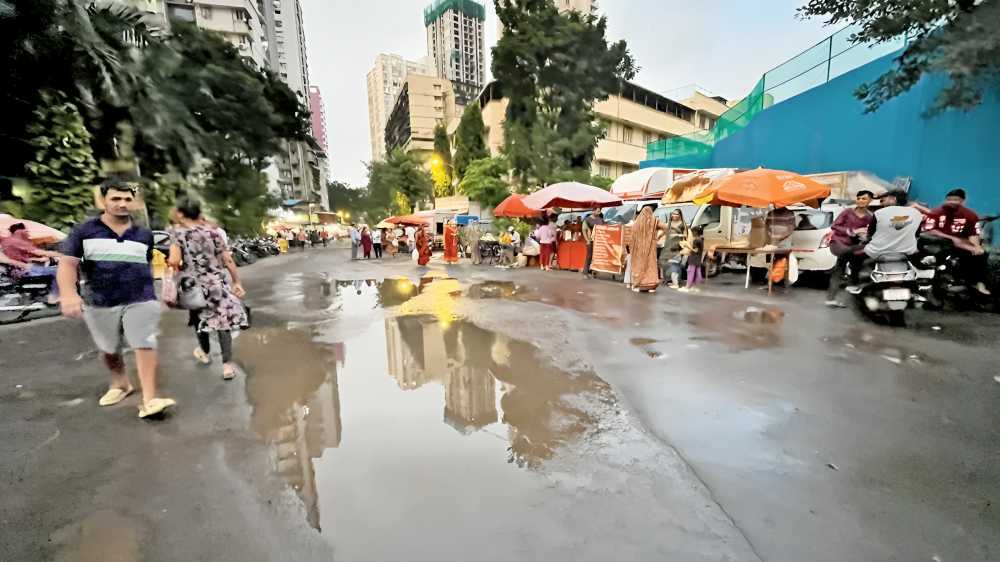
Dr Palve added that concretisation has reduced natural water absorption, forcing rainwater to accumulate on roads and footpaths. “In a natural landscape, a lot of rainwater seeps into the soil. Once roads, footpaths, and open spaces are concreted, that absorption is lost. When old structures, open grounds, gutters, and footpaths are dug up or concreted, rodents lose their natural habitats. They live, roam around and urinate in the same area as these concrete roads. When people walk through this contaminated water on the road with cuts or abrasions on their feet, bacteria causing leptospirosis can enter the body. The same water often mixes with overflowing sewage, increasing the risk of gastroenteritis, typhoid, and cholera,” he said.
Dr Nitin Karnik, head of the medicine department at Sion Hospital, highlighted that construction waste can worsen drainage issues. “Construction material, cement slurry, and plastic waste frequently find their way into drains, reducing their carrying capacity. The result is prolonged water stagnation after rainfall. Old drainage systems are already under pressure, and when rainwater mixes with overflowing sewage, residents become vulnerable to hepatitis A and E, diarrhoea and other infections,” he said.
Doctors stressed that better construction site management, proper drainage and regular monitoring of stagnant water can help reduce monsoon health risks in Mumbai.
Source: Mid-day