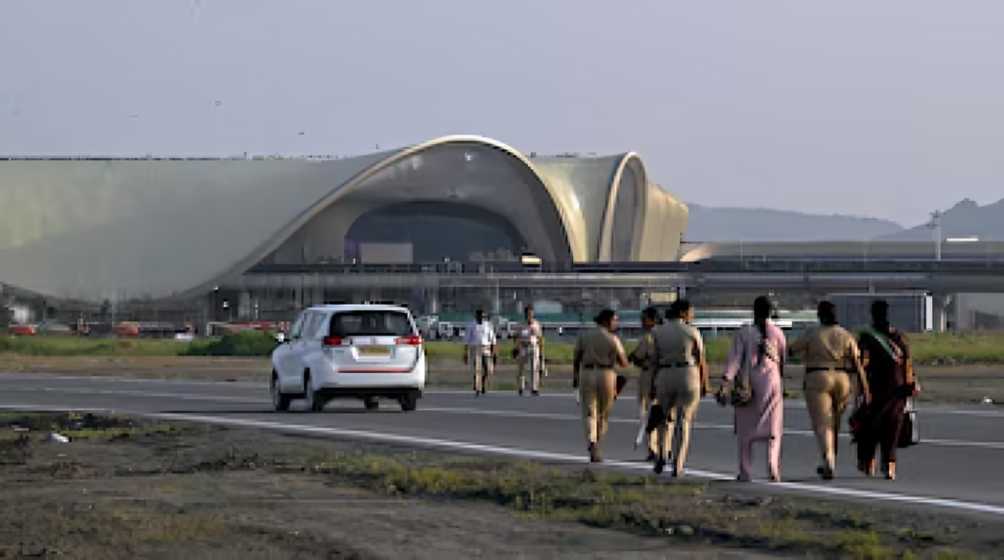

Adani Airport Holdings Ltd (AAHL) will proceed with the next phase of expansion at Navi Mumbai International Airport (NMIA) after the monsoon, even as airline operations continue to grow more slowly than initially expected. The company aims to increase the airport’s annual passenger handling capacity from 20 million to between 60 million and 65 million by 2029-30.
Speaking during the company’s post-earnings conference call, AAHL Chief Executive Officer Arun Bansal said design work for the expansion is at an advanced stage and excavation will begin once the monsoon concludes.
“We are in a very advanced stage of design work and excavation work will start as soon as the monsoon ends this year. The biggest milestone for the next three quarters is to get NMIA at an operating capacity of 20 million passengers annually and that is our immediate focus,” Bansal said.
Developed as Mumbai’s second international airport, NMIA is intended to ease congestion at Chhatrapati Shivaji Maharaj International Airport (CSMIA). Spread over more than 1,160 hectares, the greenfield airport is being developed in phases and is ultimately expected to handle around 90 million passengers annually while also serving as a major cargo hub for western India.
Commercial operations at NMIA began on December 25, 2025. However, airline participation has remained limited, with IndiGo operating the majority of flights. According to Flightradar24 data, the airport currently records around 85 to 95 aircraft movements daily, with IndiGo accounting for more than 80% of these operations.
Air India has not yet launched its full-service operations from NMIA. Its subsidiary, Air India Express, currently operates services to Delhi, Bengaluru and Abu Dhabi. Meanwhile, Akasa Air continues to maintain a limited presence, operating flights to Delhi, Kochi and Varanasi after discontinuing its Navi Mumbai-Noida and Navi Mumbai-Bengaluru routes.
According to AAHL’s FY26 annual report, NMIA handled 0.64 million passengers and 4,510 air traffic movements during its first year of operations. During the same period, Mumbai airport recorded 55.29 million passengers and 331,756 aircraft movements.
Industry experts note that gradual traffic growth is common at newly commissioned airports, as airlines typically expand operations in phases based on passenger demand. Similar trends were observed at Goa’s Mopa airport before airlines gradually increased their network.
Despite the slower start, AAHL expects passenger demand in the Mumbai Metropolitan Region to rise from approximately 64 million in 2022 to nearly 116 million by 2030. The company believes NMIA will play a key role in accommodating this future growth, although attracting more airlines remains essential for the airport’s long-term success.
Source: Money Control